
 Linkedin

 Facebook
 Email
 more

AI 可以改變員工調查問題、作出決策及完成工作的方式,ERP 則繼續作為企業的核心交易紀錄系統。本系列將以同一個「訂單到收款」情境,探討企業在規劃、導入及持續管理 AI 時需要作出的決定,以及如何衡量其商業價值。

客戶因發票價格與約定條款不符而提出異議。應收帳款團隊核對發票,營運團隊檢查訂單,另有同事從電子郵件中尋找當初的協議。與此同時,該筆發票已列入逾期清單,催收人員正準備發出付款提醒,而財務總監也在詢問,為何每月管理報告中的應收帳款有所增加。
交易已記錄在企業資源規劃(ERP)系統中,但要解釋這筆交易,員工仍須在不同畫面、訊息和試算表之間查找及整理資料。
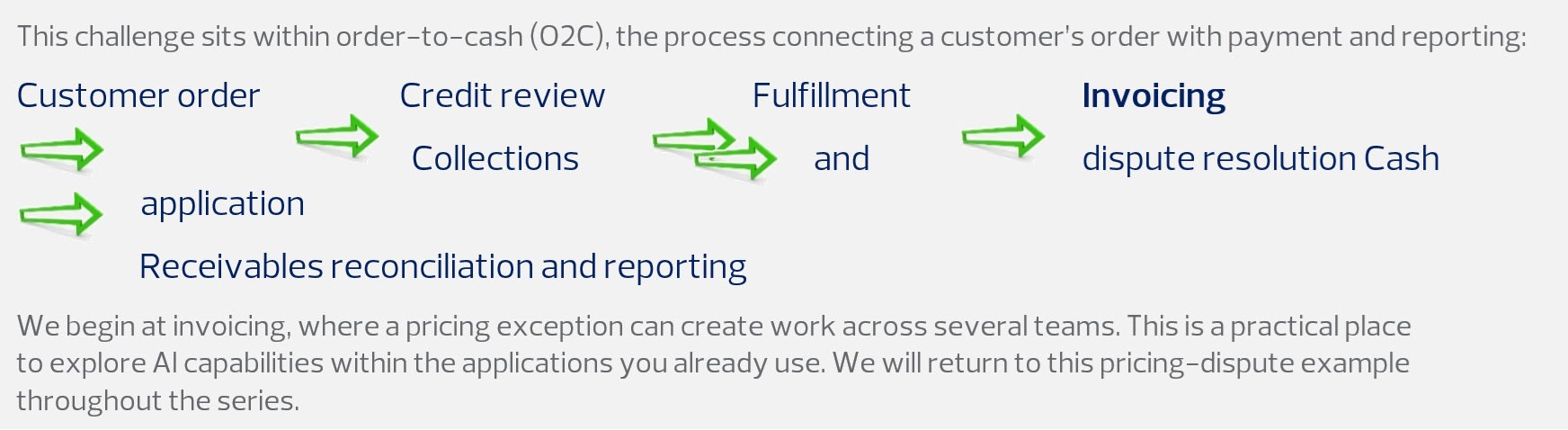
ERP 繼續負責管理交易
在這個流程中,ERP 仍負責保存發票、收款、貸項調整及未收款餘額的正式紀錄。視乎已配置的模組,系統亦可支援爭議追蹤、款項催收、帳齡報告及管理報告。
這些既有功能本身已有價值。即使尚未導入 AI,團隊也可透過檢視未結交易、已記錄的爭議、付款承諾及客戶往來紀錄,調查逾期餘額的原因。
以這筆有爭議的發票為例,現有功能可以顯示發票金額、付款到期日及已記錄的爭議狀態。但員工仍可能需要調查價格差異的原因,並決定下一步如何處理。
加入 AI 時,應保留原有的控制措施。更正發票仍須取得適當批准,貸項調整仍須入帳,管理報告仍須採用一致的定義及經核對的數字。流程負責人亦須繼續對相關決策承擔責任。
ERP 內建 AI 如何改變日常工作
一筆有爭議的發票會衍生多種工作,AI 在各個環節可以提供不同協助。以下有官方文件支持的功能,說明員工的工作方式可能如何改變。
| Putting the exception in context. A collector needs to understand the customer’s objection before choosing the next action. AI can reduce the effort of reconstructing that history. Oracle Fusion Cloud Financials, for example, summarizes account context and recommends next steps; configured email intelligence also summarizes correspondence. The collector starts with a summary to verify, then checks the pricing agreement to determine whether a correction is warranted. | Reconciling the outstanding balance. Before pursuing payment, the team needs to establish which receipts belong to which invoices. SAP Cash Application uses machine learning to propose matches, reducing routine manual comparison so staff can concentrate on unresolved items. In the disputed-invoice workflow, this helps establish what has already been paid. The capability is delivered through a service integrated with SAP S/4HANA and requires setup. |
| Preparing customer communication. A reminder should reflect the account’s current position, including any unresolved dispute. Embedded AI can give the collector an account summary and a draft to review, as Copilot does in Microsoft Dynamics 365 Finance. Time previously spent gathering account information and composing a message can shift toward checking its accuracy and deciding whether it is appropriate to send. Financial calculations remain in the ERP. | Developing management commentary. At month-end, finance needs to explain the receivables position. NetSuite Narrative Insights can provide a starting point by summarizing the standard A/R Aging Summary report; customized reports are not supported. Finance reviews the summary and investigates the reasons behind the figures. The report alone does not establish why an invoice is overdue, so the team still checks the dispute record before attributing delayed payment to the pricing issue. |
An AI agent could also reduce the manual coordination needed to resolve a disputed invoice. For example, it might create a follow-up task or route the dispute to its owner. These are illustrative possibilities that depend on the application and its configuration. The business would define what the agent can do and which actions require approval, while financial changes would continue to be recorded in the ERP.
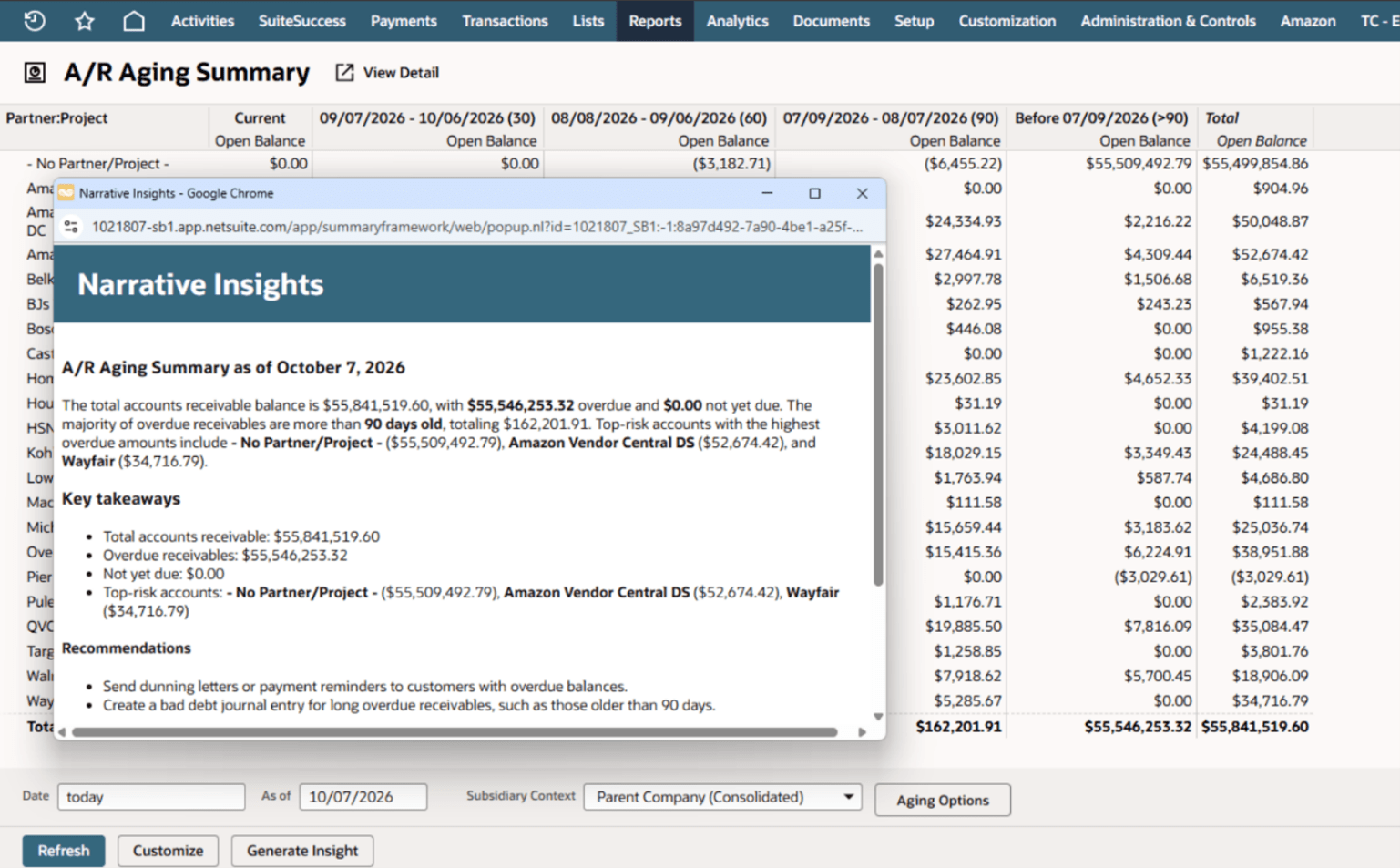
Fig.1 NetSuite Narrative Insights
Start with your current application landscape
Before choosing an AI capability, bring finance, operations and IT together to answer four practical questions.
What do we already have?
Inventory the applications supporting invoicing, collections and reporting, including their versions, enabled modules, licenses and existing AI capabilities. Verify what your entitlements cover, any additional costs and availability in your region. Distinguish functionality you can demonstrate in your environment from previews and announcements.
What are we trying to improve?
Trace a disputed invoice and note where employees leave the application to complete their work. Email searches for agreed prices; separate dispute spreadsheets and manually drafted report commentary can expose recurring effort. Select a delay or source of rework that can be measured.
Does AI have the information it needs?
A pricing dispute may depend on ERP transactions, customer agreements, emails and supporting documents. Check whether existing integrations make that evidence accessible, current and available under the right permissions. Missing agreed terms can limit the usefulness of an otherwise accurate account summary.
Who is accountable?
Assign a process owner and define what AI is permitted to prepare, recommend or execute. Specify which invoice corrections, customer communications and reporting decisions require approval, who provides it and how the application enforces those controls.
⇒ Establish a baseline before changing the process. Measure monthly invoice and exception volumes, handling minutes, days to resolution, collections follow-ups and reporting hours. Record the percentage of cases requiring correction and reminders sent incorrectly.
⇒ For illustration, 300 exceptions a month at 12 minutes each represent 60 handling hours. A 5% rework rate means 15 cases need correction. Use your own measurements, then compare pilot results using the same definitions, including review of time and technology costs.
⇒ Use these answers to complete your application inventory and select one process to explore with AI. Its baseline, information needs and approval requirements provide the basis for assessing whether existing capabilities can support the improvement or a different approach is needed.
How RSM supports the full AI lifecycle | ||
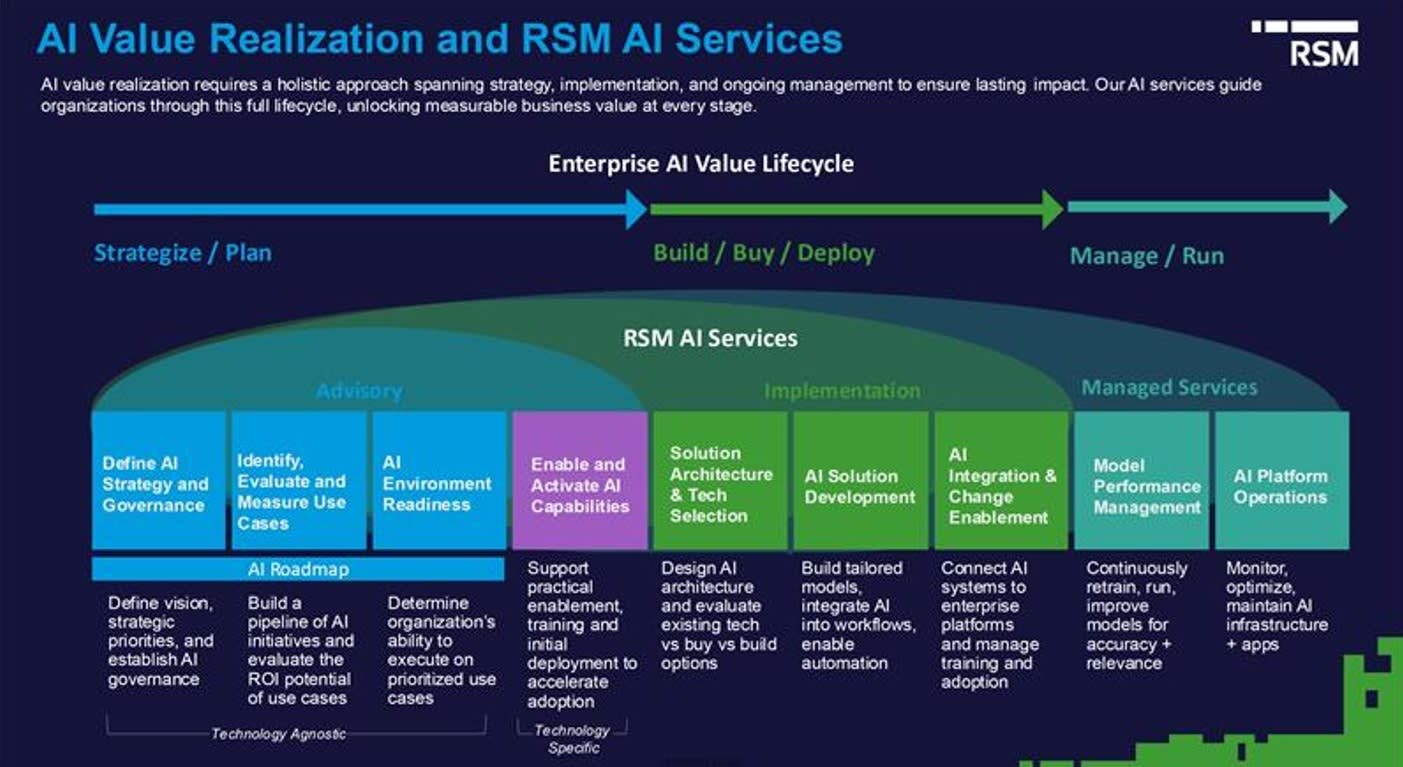
| Resolving the pricing dispute with AI involves a connected set of decisions: where to start, how to implement the solution and how to keep it useful in daily operations. RSM’s AI services support that full lifecycle. | ||
Figure 2. RSM AI services across the enterprise AI value lifecycle. | ||
Strategize and plan. Define AI strategy and governance, prioritize use cases and measure their potential value, and assess environment readiness. For this invoice, the starting point is the investigation delay, the evidence needed and the outcome the process owner wants to improve. | Build, buy and deploy. Enable existing AI capabilities, select the architecture and technology, develop solutions where needed, and integrate them with training and change support. The team can test an account summary, assess whether it needs connected evidence retrieval, and prepare users to review outputs and handle exceptions. | Manage and run. Monitor model performance and operate the AI platform and applications. As pricing terms, documents and integrations change, check whether explanations remain accurate, resolve service issues and compare ongoing cost with the process improvement achieved. |
RSM combines ERP and finance process expertise with these services. Our Enterprise Application AI Readiness Assessment examines your applications, priority use cases, data and integration, and controls and economics. It produces a practical roadmap for implementation and ongoing management. Contact our team to discuss a priority process.
In the next article, we will return to this pricing dispute and compare the potential use cases: Which AI use case should we fund first, and how will we measure its value?
The value of AI in ERP is not automation alone, but better decisions grounded in trusted data, clear controls and accountability, helping people resolve exceptions and improve everyday business outcomes.