
 Linkedin
 Facebook
 Email
Email more
more
In mid-December, 2025, the Indonesian government updated the framework for setting Provincial Minimum Wages (UMP) and Regency/City Minimum Wages (UMK). With application for 2026, these updates carry significant implications for labor-intensive industries, payroll budgeting, and long-term investment strategy. The UMP, UMK and any sectoral minimum wages apply for employees that have less than one year of work experience.
The Regulatory Framework: Transitioning to GR 49/2025
Government Regulation (PP) No. 49 of 2025 amended the previous framework for setting UMP and UMK (PP 36/2021 and PP 51/2023) following a Constitutional Court decision (No. 168/PUU-XXI/2023) which mandated that wage formulas better reflect a "decent standard of living”.
A key aspect is the adjustment of the "Alpha" coefficient. This is now set between 0.5 and 0.9. This higher range ensures that workers receive a larger share of regional economic growth compared to previous years, where the alpha was capped at 0.3. As a consequence, all things equal, there is potential for relatively higher increases in UMP and UMK for 2026 and future years compared to previous years.
2026 UMP and UMK for Jakarta and West Java
DKI Jakarta (Provincial Minimum Wage)
Under Governor Decree (Keputusan Gubernur) No. 1142 dated 23 December 2025:
- 2026 UMP: IDR 5,729,876.
- Increase: Approx. 6.17% (previously IDR 5,396,761 for 2025).
- Calculation Note: The Jakarta government utilized an Alpha coefficient of 0.75, that was justified as balancing worker purchasing power with business sustainability.
West Java (Regency/City Minimum Wage)
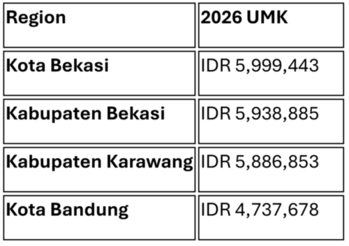
The UMP for West Java is set at IDR 2,317,601 for 2026. However, the UMK are more critical because these can vary significantly from the UMP. For West Java, 2026 UMK amounts stipulated in West Java Governor Decree No. 561/Kep.862-Kesra/2025 include:
Note:
For the first time, the industrial hubs in West Java (Bekasi and Karawang) have surpassed Jakarta's UMP.
Insights for Companies and Investors
- Structure and Wage Scales
Companies must remember that the regulated minimum wage applies only to workers with less than one year of service. For 2026, the Ministry of Manpower is heightening enforcement on the implementation of Wage Scales. Employers should review their internal grading systems to ensure seniority and performance are appropriately compensated above the new floor. This does not require that all salaries are increased by the same percentage as the revision to the UMP/UMK, however, the employer should be ready to explain the reason for any revision that is less than the increase to the UMP/UMK. - Compliance Risk
With the reintroduction of Sectoral Minimum Wages [NG2.1][PB2.2]in certain regions, effective from January 2025, companies in construction, energy, and high-tech manufacturing may face higher minimum wage floors than the UMP/UMK. Therefore companies should ensure they are aware of all applicable minimum wages to avoid administrative sanctions or industrial disputes. - BPJS Contributions
If the new UMP/UMK results in increased salaries then this will also result in higher on-costs for BPJS, THR, overtime and other payments linked to salary.
For Potential Investors: "Efficiency Over Low Cost"
GR 49/2025 brings greater clarity and consistency to wage setting in Indonesia. As a result, investors are encouraged to shift their focus from minimizing labor costs to improving efficiency, productivity, and long-term operational sustainability.
- Predictability vs. Growth
The shift to GR 49/2025 provides a clearer formula, reducing the "surprise factor" of annual negotiations. However, investors must pivot from a "low-cost labor" mindset to a "high-productivity" mindset. - Regional Selection
West Java offers a wide spectrum of costs. While Bekasi and Karawang are premium industrial zones, other regions in West Java offer significantly lower entry points for labor-intensive operations, provided the infrastructure meets logistical needs. - Incentives and Automation
To offset rising labor costs, the government is[PB3.1][PB3.2] offering incentives for MSMEs and streamlined licensing for companies investing in high-tech sectors. Investors should consider accelerating automation in their Indonesian facilities to maintain regional competitiveness against neighboring competition like Vietnam or Thailand.
RSM Indonesia’s Perspective
Navigating the complexities of Indonesian labor law requires a proactive approach. In this context, Payroll Administration and Advisory may be relevant for employers, including monthly payroll management and Advisory related to applicable labor law which impacting payroll activity.

