
 Linkedin
 Facebook
 Email
Email more
more
The world generated approximately 2.56 billion tonnes of municipal waste in 2022, and this figure is projected to reach 3.86 billion tonnes by 20501 . Waste volumes are increasing faster than many countries can develop the collection, sorting, recycling and treatment infrastructure needed to manage them. The result is growing pressure on the environment, public health, urban development and public finances.
Against this backdrop, governments are increasingly turning to Extended Producer Responsibility (EPR) as a core policy instrument. The principle is straightforward: companies that place products on the market should take responsibility for the waste those products generate once they reach end of life.
EPR has become a central pillar of European waste legislation and is embedded in the EU Waste Framework Directive2. While schemes differ from one country to another, the underlying objectives and obligations are increasingly converging.
WHY WAS EPR DEVELOPED?
Historically, municipalities and taxpayers carried most of the financial burden of collecting and managing waste. As waste volumes increased and recycling targets became more ambitious, this model proved increasingly difficult to sustain.
EPR was introduced to shift part of that responsibility upstream to producers, following the "polluter pays" principle. Rather than treating waste management as a purely public service, EPR incorporates those costs into the true cost of products placed on the market.
The objective is not only to finance waste management but also to influence business decisions. By making producers responsible for end-of-life costs, EPR creates an incentive to reduce waste, increase recyclability and improve product design.
One of the key drivers behind EPR is the recognition that around 80% of a product's environmental impacts are determined at the design stage. Decisions regarding materials, durability, reparability and recyclability are made long before a product becomes waste. EPR seeks to bring those considerations into business and product development decisions.
WHAT IS EPR IN PRACTICE?
At its core, EPR transfers responsibility for waste management from municipalities to producers.
This responsibility can be financial, operational, or a combination of both.
In a financial EPR system, public authorities continue to organise waste collection and treatment, while producers finance those activities through EPR fees. These contributions are often misunderstood as a tax, but they are more accurately described as payment for a service that funds collection, sorting, recycling and reporting activities.
In an operational EPR system, producers take a more active role and are responsible for organising waste collection and recovery themselves, usually through collective compliance schemes.
In both models, producers ultimately contribute to ensuring that products are properly managed once they become waste.
WHICH PRODUCTS ARE COVERED?
EPR schemes have traditionally focused on specific product sectors rather than individual materials.
The most established schemes cover:
- Packaging
- Waste Electrical and Electronic Equipment (WEEE)
- Batteries and accumulators
- End-of-life vehicles
- Waste oils
In addition, several countries have already introduced EPR schemes for additional product streams, including furniture, mattresses, printed paper, tobacco products, fishing gear and certain construction products, depending on national legislation.
The scope of EPR is also expanding at EU level. Under the revision of the Waste Framework Directive3, textiles and footwear have been added to the products subject to EPR requirements, signalling a broader shift towards producer responsibility across a wider range of sectors.
HOW ARE EPR SCHEMES ORGANISED?
EPR policies are typically established by national governments, often through the public authorities responsible for waste management. While implementation differs between countries, Article 8a of the EU Waste Framework Directive4 establishes a common set of minimum requirements.
These requirements include clear allocation of responsibilities between producers, compliance organisations, waste operators and public authorities. They also require robust reporting systems capable of tracking products placed on the market, waste collection volumes and treatment outcomes.
Equally important is transparency. Authorities must ensure that EPR systems have adequate monitoring, enforcement and auditing mechanisms to verify compliance and ensure that producer contributions are used for their intended purpose.
THE ROLE OF PRODUCER RESPONSIBILITY ORGANISATIONS (PROS)
Most companies do not manage their EPR obligations individually. Instead, they join a Producer Responsibility Organisation (PRO), which carries out many of the operational and administrative requirements on behalf of multiple producers. PROs typically organise collection and treatment activities, consolidate reporting and manage compliance with national authorities.
While membership of a PRO can simplify compliance, it does not remove responsibility from the producer. Companies remain accountable for providing accurate market data and ensuring their obligations are fulfilled.
HAVE EPR SCHEMES BEEN EFFECTIVE?
EPR is no longer an experimental policy tool. Some schemes have been operating for more than 30 years, providing substantial evidence of their impact.
Experience across OECD countries shows that EPR has contributed to:
- Greater transparency in material and financial flows
- Dedicated and predictable funding for waste management systems
- Higher separate collection rates
- Increased recycling and material recovery
- Reduced financial burden on municipalities
Most importantly, EPR has helped establish a direct connection between product design decisions and end-of-life costs, creating incentives for continuous improvement.
ARE YOU IN SCOPE?
In the EU, Extended Producer Responsibility (EPR) is not one single law covering all products. The general framework is established by the Waste Framework Directive (WFD 2008/98/EC, Articles 8 and 8a), while specific product streams (packaging, WEEE, batteries, etc.) have their own legislation.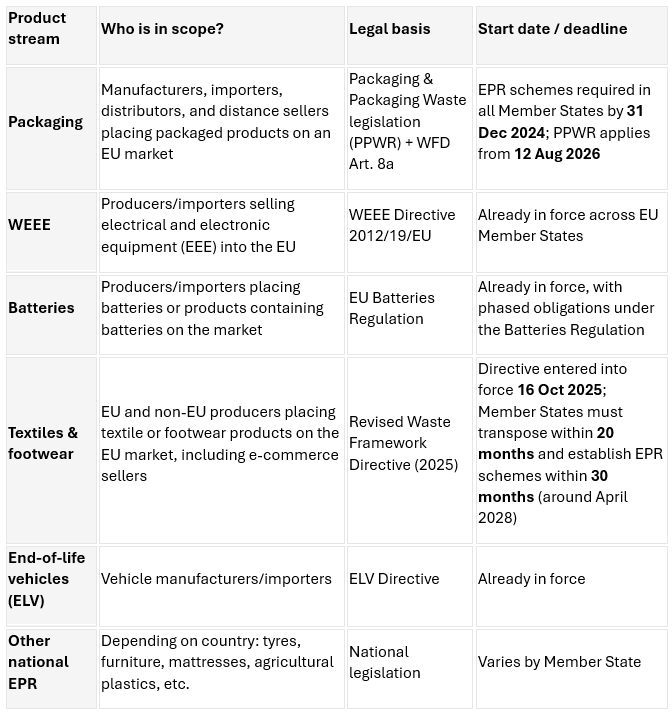
HOW EPR TRANSLATES IN BELGIUM?
Belgium applies EPR through sector‑specific Producer Responsibility Organisations (PROs) and regional authorities (OVAM in Flanders, SPW Environnement in Wallonia, Bruxelles Environnement in the Brussels‑Capital Region). The system is mature, highly structured and characterised by strong recycling outcomes across all major waste streams.
In practice, EPR in Belgium is implemented through well‑established sectoral PROs, including Fost Plus for household packaging, Valipac for industrial packaging, Recupel for WEEE, Bebat for batteries, Febelauto for end‑of‑life vehicles, Recytyre for tyres.
Companies placing products on the Belgian market must:
- Register with the relevant PRO
- Declare annual quantities placed on the market
- Pay sector‑specific contributions
- Ensure accurate, auditable data
- Comply with take‑back obligations (for EEE, batteries, tyres)
Belgium will also need to establish an EPR scheme for textiles and footwear by 2028, in line with EU requirements.
WHY ACT NOW?
For many organisations, the greatest challenge is not paying EPR fees. It is having the information needed to comply.
EPR requires data that many businesses have never systematically collected before. Companies increasingly need visibility over packaging weights, material composition, quantities placed on the market and product flows throughout the year.
Building this capability takes time. Internal data collection processes must be developed, responsibilities assigned and reporting mechanisms established. In many cases, businesses also need to identify and contract the appropriate Producer Responsibility Organisation.
Waiting until reporting deadlines approach can create significant operational challenges.
There are also direct compliance risks. Depending on the jurisdiction, authorities may impose fines, administrative penalties or restrictions on placing products on the market. In some cases, non-compliance can affect business continuity.
Beyond compliance, however, EPR should be seen as a strategic business issue. Companies that understand their material flows, improve product design and prepare for future regulatory developments are likely to be better positioned both financially and competitively.
CONCLUSION
Extended Producer Responsibility represents a fundamental shift in how products are managed at the end of their life. Rather than relying solely on municipalities and taxpayers, EPR places responsibility on those who introduce products to the market and are best positioned to influence their design.
For businesses, EPR is no longer simply a waste management requirement. It is an increasingly important part of product strategy, regulatory compliance and sustainable business practice. Organisations that prepare early, strengthen their data capabilities and integrate circular economy principles into product design will be better equipped to navigate the rapidly evolving regulatory landscape.