
 Linkedin
 Facebook
 Email
Email more
more
Key takeaways

With the 2026 Social Security Financing Act, a new birth leave has been introduced

Under this law, each parent will be entitled to an additional birth leave of one or two months.

Our experts break down the key points of this new supplementary birth leave.
The birth leave has been introduced, marking a significant evolution in the rights granted to parents at the time of a child’s arrival.
Duration, eligibility, and how it interacts with existing leave entitlements, this updated framework already raises numerous operational questions for both employers and employees. Our experts break down the key points of this new supplementary birth leave for you.
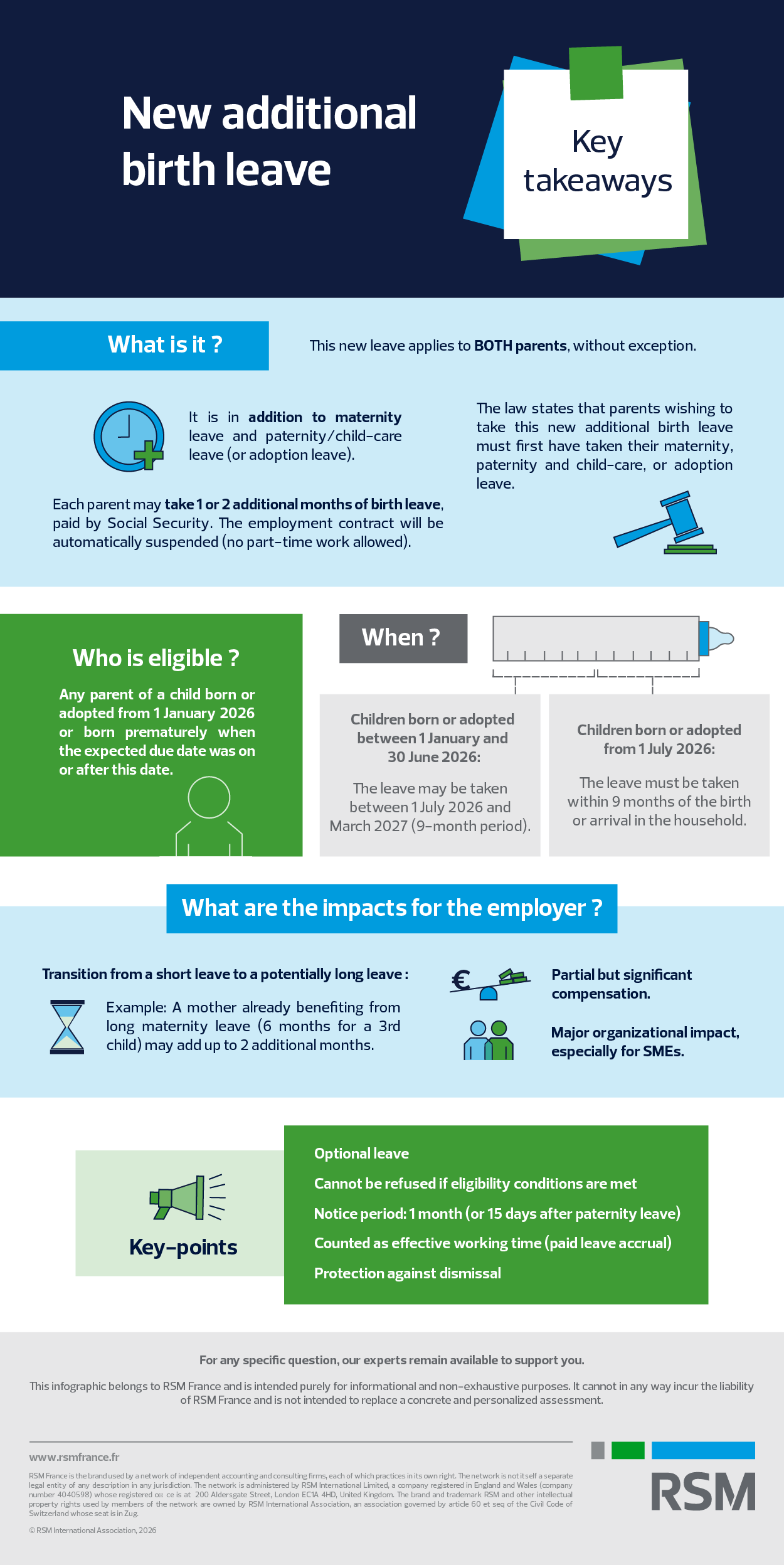
Discover our infographic on the subject
Birth Leave: What Is It?
Details of the New Birth Leave
The 2026 Social Security Financing Act provides that each parent will be entitled to an additional birth leave of one or two months, compensated by Social Security. The employment contract will be automatically suspended during this period (part-time work is not allowed).
The CNAM emphasizes that, as required by law, parents wishing to take this supplementary birth leave must first have taken their maternity, paternity, or child/adoption leave, as applicable.
This requirement does not apply to employees who are unable to exercise this right because they do not meet the conditions for receiving the social security benefits associated with the relevant leave (Labor Code art. L. 1225-46-2 / Law art. 99, VI; Labor Code art. L. 1225-46-2, new).
Who is eligible?
Any parent of a child born or adopted on or after January 1, 2026—or of a prematurely born child whose expected birth date falls on or after this date—will be eligible for this new leave.
When
Transitional provisions apply to parents of children born or arriving in the household between January 1 and June 30, 2026 (or born prematurely but expected after January 1). They may take the supplementary birth leave within a maximum of nine months from July 1, 2026, i.e., until March 31, 2027.
For parents of children born or arriving from July 1, 2026, the leave must be taken within nine months from the child’s birth or, for adoptive parents, from the child’s arrival in the household.
Employers will need to anticipate and adapt
→Shift from a short leave to a potentially long one
→Partial but significant compensation
→Major organizational impact, especially for SMEs
Overall framework effective from July 2026


Key Points to Remember
- Is this leave mandatory?
No. It is optional, unlike the four mandatory days of paternity leave.
- Can it be refused?
No, provided the legal conditions are met and the notice period is respected (decree forthcoming).
- Notice period?
(c. trav. art. L. 1225-46-2 nouveau : décret à paraître)
– One month in advance
– Fifteen days if taken immediately after paternity leave
- When can the leave be taken?
(c. trav. art. L. 1225-46-2 nouveau : décret à paraître)
A decree will specify the timeframe within which the leave must be taken, taking into account situations where maternity leave may be extended (e.g., hospitalization of the newborn).
- Can it be taken in multiple periods?
Yes, in two separate one-month periods.
- Does the employee accrue paid leave?
Yes. The period is considered as effective working time. The employee may not engage in any other professional activity during the leave (Labor Code art. L. 1225-46-4, new).
- Is there protection against dismissal?
Yes, similar to other parental-related leave protections.
- Can it be combined with parental leave?
Yes, the two entitlements are cumulative but distinct.
- Can the employee return to work early?
In the event of the child’s death or a significant reduction in household income, the employee may resume work before the end of the scheduled leave (Labor Code art. L. 1225-46-5, new).
- Implications for employers
Careful planning is required regarding replacement, organization, cost of absence, and employee protection.
In practice, the supplementary birth leave represents an important step forward in supporting parents, while introducing new obligations and challenges for employers.
Anticipation, organization, and clear communication with employees will be essential to ensure smooth implementation and regulatory compliance.
Our experts remain available to guide you through understanding and applying this new measure.

RSM experts, specialists in HR, Social, and Payroll Consulting, support companies across all sectors in defining and implementing their strategies. Our tailor-made solutions are adapted to the size, maturity, and industry of your business.
Discover our HR, Social & Payroll Consulting services.