
 Linkedin

 Facebook
 Email
 more

An independent executive assessment to understand technology exposure, clarify priorities and define an actionable roadmap.
Understand your technology exposure before deciding what comes next
Technology supports business performance, resilience, growth and transformation. Yet technology risks are often considered separately across systems, cybersecurity, data, suppliers, investments and change.
This can make it difficult for leadership to maintain a consolidated view of where the organisation is materially exposed, what should be prioritised, who owns the decisions and which actions should come first.
IT Risk & Governance 360 brings these dimensions together into one executive view, helping leadership move from fragmented findings to clear priorities, ownership and action.
When does IT Risk & Governance 360 fit?
IT Risk & Governance 360 can provide greater clarity when:
- there is no consolidated view of technology exposure;
- technology, cyber and transformation risks are being addressed separately;
- priorities and investment decisions are difficult to align;
- responsibilities and decision rights are unclear;
- management needs an independent view before committing significant resources;
- existing assessments generate findings without a clear and prioritised roadmap.
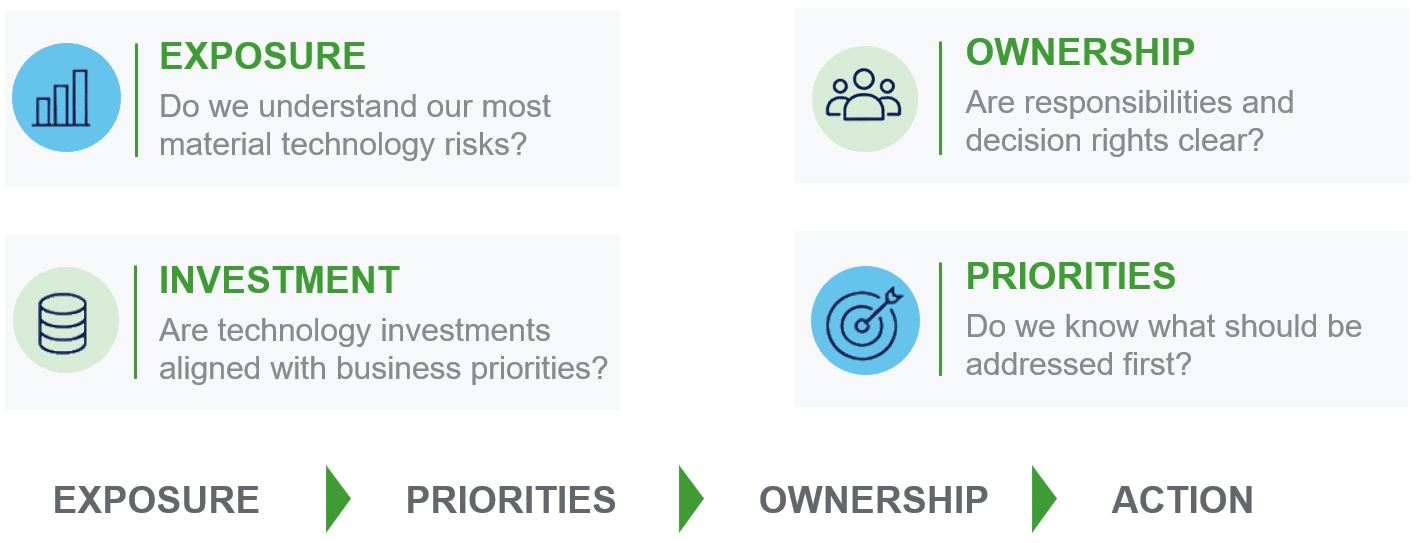
A 360° view of technology exposure
Technology risk cannot be understood by looking at individual systems or controls in isolation. IT Risk & Governance 360 examines the broader business exposure created by technology, dependencies and change.
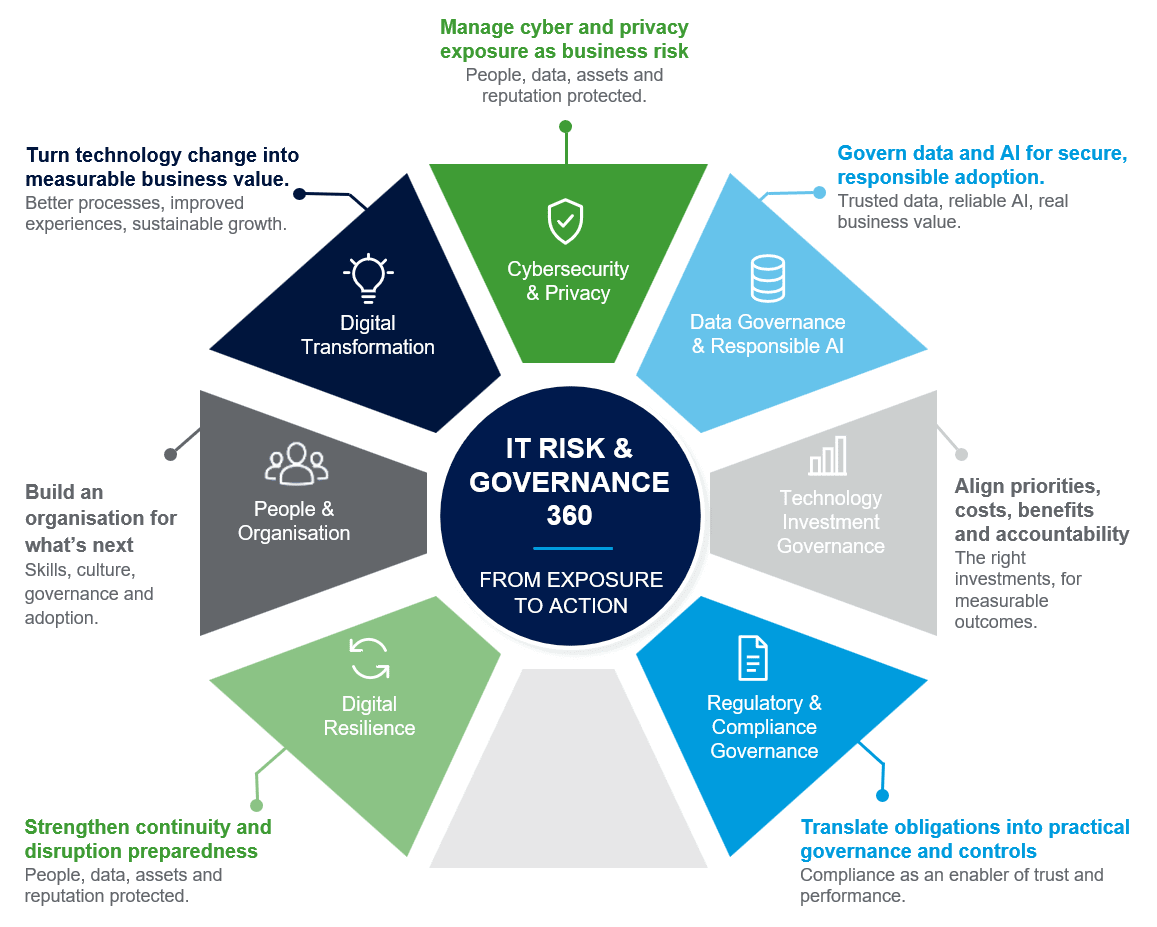
The objective is not to review technology in isolation, but to understand where exposure matters to the business, clarify ownership and define prioritised action.
From risk exposure to informed decisions
Risk assessment becomes valuable when leadership can distinguish between the organisation’s underlying exposure, the effect of existing controls and the level of risk it is prepared to accept.
Inherent risk
Inherent risk represents the level of exposure before controls, safeguards or other mitigation measures are considered.
It provides a view of the underlying risk associated with a technology, process, supplier or transformation initiative.
Residual risk
Residual risk represents the exposure that remains after relevant controls and mitigation measures have been applied.
It helps leadership understand the risk the organisation continues to carry after considering existing safeguards.
Risk appetite
Risk appetite defines the level of residual risk an organisation is prepared to accept in pursuit of its objectives.
Comparing residual exposure with risk appetite helps management determine where additional action is required and where risk may reasonably be monitored or accepted.
Likelihood, impact and risk prioritisation
Risk assessment typically considers two complementary dimensions: likelihood and impact.
Likelihood
Likelihood reflects the probability that a risk event may occur and provides a consistent basis for comparing exposures.
Impact
Impact considers the potential consequences of a risk event across areas such as operations, finance, regulation, reputation and business objectives.
Combining likelihood and impact enables organisations to position inherent and residual risks, compare exposures and prioritise appropriate responses.
Using the risk matrix to support decisions
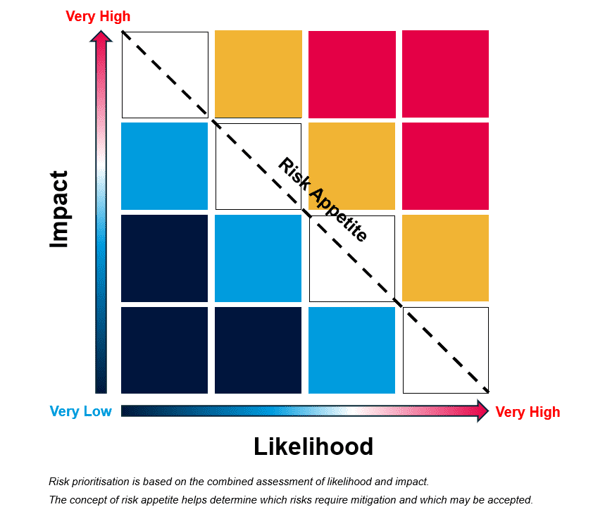
The risk matrix supports management decisions by distinguishing exposures that require mitigation, monitoring or acceptance in line with the organisation’s risk appetite.
Risk management is not about eliminating risk, but about enabling informed decision-making and reducing uncertainty.
Governance turns risk insight into action
Risk assessments and frameworks only create value when supported by clear governance.
Effective IT risk governance helps establish:
- who owns each material risk;
- who has authority to make decisions;
- how risk responses are prioritised;
- how residual exposure is accepted or escalated;
- how actions are monitored and reported;
- how leadership maintains visibility as technology and business conditions evolve.
Recognised risk and control frameworks can provide a common language and structure, but they should be adapted to the organisation’s size, activities, regulatory environment and objectives rather than applied mechanically. C’est également un point central de la page actuelle à préserver.
What do you receive?
Executive view
A consolidated view of technology exposure, dependencies and priorities.
Prioritised risks
Clear identification of the issues requiring leadership attention.
Ownership & accountability
Clarification of responsibilities and decision ownership.
Prioritised recommendations
Practical actions focused on business impact and urgency.
Actionable roadmap
A structured sequence of agreed priorities and next steps.
From assessment to action
Our approach moves from the business context and technology exposure to clear priorities, ownership and coordinated action.

Frame
Clarify the business situation, decisions, risks and constraints.
Assess
Establish exposure, priorities, dependencies and leadership needs.
Decide
Select the right priorities and define ownership.
Act
Launch the roadmap and agreed next steps.
Explore IT Risk & Governance 360 in more detail
Discover how IT Risk & Governance 360 helps leadership understand technology exposure, prioritise risk, clarify ownership and define an actionable roadmap.


