Linkedin
 Facebook
 Email
Email more
more
Legislation Driving BEPS 2.0 Two-Pillar Solution
In July 2021, the OECD announced its landmark two-pillar international tax reform framework to address base erosion and profit shifting risks arising from the digitalisation of the economy. Pillar Two (GloBE Rules) — the Global Minimum Tax — targets MNE Groups with annual consolidated revenue of EUR 750 million or above, ensuring they pay a minimum effective tax of 15% on excess profits derived from every jurisdiction they operate in.
Effective Date of the UAE’s Pillar Two Global Minimum Tax Regulations
The UAE adopted the OECD Pillar Two framework by introducing the Qualified Domestic Minimum Top-Up Tax (QDMTT), effective January 1, 2025. This tax aligns with global minimum tax rules set by the OECD and G20 Inclusive Framework on Base Erosion and Profit Shifting (BEPS).


Pillar One
Reallocating consolidated MNE profits to jurisdictions where sales arise, and standardizing remuneration for routine marketing and distribution activities.

Pillar Two
Ensures MNE Groups pay a minimum tax of 15% on Excess Profits in every jurisdiction through two interlocking rules: the Income Inclusion Rule (IIR) and the Undertaxed Profits Rule (UTPR) — collectively the GloBE Rules and Domestic Minimum Top-up Tax (DMTT)
Who is Subject to Pillar Two Regulations in the UAE?

Constituent Entities in the UAE:
- Any entity that is part of an MNE Group meeting the €750 million revenue threshold.
- This includes Permanent Establishments (PEs) of foreign main entities if their financial results are included in the group’s consolidated statements.

Joint Ventures (JVs) in the UAE:
- Defined as entities where the Ultimate Parent Entity (UPE) holds ≥50% ownership and reports results using the equity method.
- The JV and its subsidiaries are treated as a separate MNE Group for Top-up Tax calculations, with the JV acting as the UPE.

Stateless Constituent Entities (Reverse Hybrids):
- Entities created under UAE law that are tax transparent in the UAE (not taxed at entity level) but treated as opaque by their owners’ jurisdictions (not taxed at owner level).
- These "stateless" entities are subject to Pillar Two rules to prevent tax avoidance.

Exempt Entities:
- Government Entities (including Sovereign Wealth Funds)
- International Organisations
- Non-Profit Organisations
- Pension Funds
- Qualifying Investment Funds
- Qualifying Investment Vehicles
Five Steps to Determine Top-up Tax Liability
Ensure timely compliance and align with key regulatory milestones under the UAE Pillar Two framework.
.png)
Scope & Location
Identify MNEs in scope and locate each Constituent Entity by jurisdiction.
.png)
GloBE Income
Calculate GloBE Income per Constituent Entity based on financial accounts.

Covered Taxes
Determine Covered Taxes attributable to each Constituent Entity.
.png)
ETR & Top-up Tax
Calculate Effective Tax Rate (ETR) per jurisdiction and determine Top-up Tax.
.png)
Impose IIR/UTPR
Charge any Top-up Tax prioritizing local QDMTT, eliminating secondary foreign IIR or UTPR exposure.
RSM UAE’s GloBE / Pillar Two Advisory & Compliance Support services
We provide comprehensive Pillar Two impact assessments, ETR modelling, QDMTT analysis, CbCR Safe Harbour eligibility reviews, and transition year compliance support across UAE and GCC jurisdictions.
- Determine if the MNE Group meets the EUR 750M revenue threshold across the previous four fiscal years
- Identify all Constituent Entities (CEs) and their jurisdictional locations
- Map Excluded Entities (governmental, non-profit, pension funds, investment funds as UPE)
- Calculate GloBE Income per CE using the UPE's accounting standard (IFRS or equivalent)
- Determine Covered Taxes including current and deferred tax adjustments
- Compute jurisdictional ETR and Top-up Tax percentage (15% minus ETR)
- Apply Substance-Based Income Exclusion (SBIE) for payroll costs and tangible assets
- Advise on the top-down IIR ownership chain and where Top-up Tax falls
- Assess UTPR exposure based on tangible assets and employee allocation across jurisdictions
- Structure denial of deduction or new charge approaches for UTPR implementation
- Review whether a jurisdiction's DMTT qualifies as a QDMTT
- Assess the three standards — accounting, consistency, and administration
- Evaluate Switch-off Rule scenarios and their impact on the Safe Harbour
- CbCR Safe Harbour — test eligibility under de minimis, simplified ETR, or routine profit tests for FY 2024–2026
- QDMTT Safe Harbour — assess whether full GloBE calculation relief applies
- Non-material CE simplified calculations for entities excluded from UPE consolidated statements on materiality grounds
- Recast deferred tax assets from pre-regime losses in low-tax jurisdictions to the minimum rate
- Assess eligibility for the five-year UTPR relief for MNEs in their initial phase of international activity (≤6 jurisdictions, ≤EUR 50M tangible assets outside primary jurisdiction)
- Manage the extended 18-month filing deadline in the transition year vs the standard 15-month deadline
- Prepare and file the GloBE Information Return and required notifications
- Manage jurisdictional filing obligations and deadlines across multiple territories
- Annual ETR recalculation across all in-scope jurisdictions
- Post-filing adjustments and tax rate change tracking (Art. 4.6)
- Monitor OECD Administrative Guidance updates that modify the Commentary
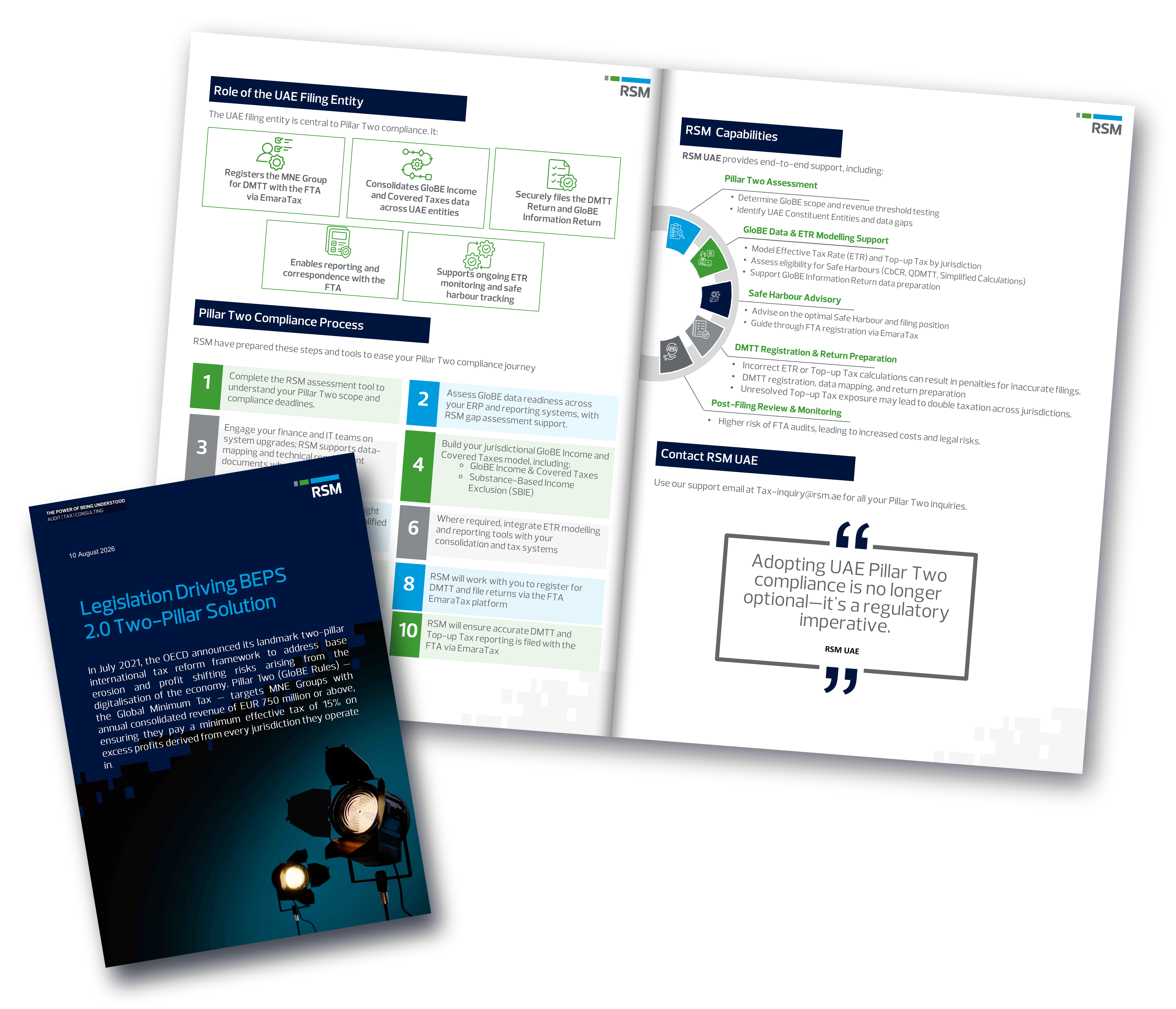
Start Your Journey By Downloading Our GloBE / Pillar Two Brochure
Learn how RSM UAE supports businesses in achieving full compliance with the UAE We provide comprehensive Pillar Two impact assessments, ETR modelling, QDMTT analysis, CbCR Safe Harbour eligibility reviews, and transition year compliance support across UAE and GCC jurisdictions..
What’s Inside:
- Overview of the UAE Pillar Two Mandate
- Key benefits of Two Mandate for businesses
- Implementation deadlines & key compliance dates
- RSM UAE’s Pillar Two impact assessments support services

Contacts Us
Contacts Us