
 Linkedin
 Facebook
 Email
Email more
more
For many businesses, packaging compliance has historically been a relatively contained annual exercise: determine the kilograms placed on a national market, submit a return and pay the applicable extended producer responsibility fee. However, the Packaging and Packaging Waste Regulation (PPWR) changes that approach.
Since 12 August 2026, the PPWR applies directly across the European Union. It covers virtually all packaging placed on the EU market, whether empty or filled, imported or produced in the EU, and regardless of material. It combines existing waste management responsibilities with new requirements covering packaging design, composition, documentation, labelling, minimisation, recycled content and reuse.
Not all these requirements apply immediately. Many of the more visible obligations will be phased in between 2027 and 2030. Nevertheless, businesses already need to understand which packaging they use, their role in each value chain and the countries in which responsibility arises. Without that foundation, they cannot reliably manage either today's EPR obligations or the product requirements that follow.
This article was written by Bart Ladru and Kirill van der Velde. Bart and Kirill are consultants with RSM Netherlands with a focus on ESG and supply chain management.
What does the PPWR change for packaging compliance?
More than new packaging design rules
The PPWR replaces the former Packaging and Packaging Waste Directive with a directly applicable regulation. Its objective is to reduce packaging waste, improve recyclability, increase the use of recycled materials and develop functioning reuse systems across the EU. Its scope is deliberately broad. It includes not only the box, container or wrapper around the product sold to customers, but potentially also labels, closures, sleeves, grouped packaging, pallets, stretch wrap, straps, shipping boxes, e-commerce bags and service packaging filled at the point of sale.
The Regulation therefore affects far more than packaging manufacturers. It is relevant to almost every company that manufactures, imports, distributes or sells packaged products in the EU. This includes private label businesses, online sellers and industrial companies using transport packaging in B2B supply chains. The most significant change is that packaging compliance can no longer be managed solely from an annual tonnage report. The PPWR connects the design of packaging, the way products move through the market and the financing of the waste generated at the end of the chain.
Manufacturer and producer: two different PPWR responsibilities
One of the most important PPWR distinctions is between the "manufacturer" of packaging and the EPR "producer". These roles serve different purposes and may be held by different companies.
The manufacturer is responsible for ensuring that the packaging complies with the applicable sustainability, labelling and information requirements. This includes the conformity assessment, technical documentation and EU declaration of conformity. The manufacturer is not necessarily the company that physically produces the packaging. It will generally be the company that has the packaging or packaged product designed or manufactured under its own name or trademark. For sales and grouped packaging, this will often be the filler or product brand owner. For unbranded transport or service packaging, it may instead be the packaging supplier.
The producer, on the other hand, is the manufacturer, importer or distributor responsible for EPR in a particular Member State. Which company holds that role depends on how and where the packaging is made available and expected to become waste. This generally includes registration, reporting and financing packaging waste management.
The manufacturer is identified at EU level, whereas producer responsibility must be assessed for the relevant national market. A company may therefore be the manufacturer of packaging throughout the EU but be the EPR producer only in certain countries. Conversely, a distributor or importer that did not design the packaging may become the producer in the country where it is made available. The European Commission's guidance emphasises that the PPWR seeks to identify one producer for each relevant packaging flow and market. Determining that producer requires companies to consider the packaging type, the countries involved and whether the recipient is an end user or will distribute the product further.
What does the PPWR mean for existing EPR obligations?
What changes for existing EPR set-ups?
The PPWR does not create a single EU registration or payment system. EPR will continue to be administered nationally, often through national registers and producer responsibility organisations. Companies may therefore still need separate registrations, reports and fee payments in multiple Member States. What the PPWR changes is the underlying logic used to identify the responsible producer.
First, existing registrations must be reassessed against the new definitions. The legal entity that historically submitted an EPR return is not automatically the producer under the PPWR. Responsibility may differ between sales, grouped, transport, e-commerce and service packaging and can shift depending on how products are distributed.
Second, cross-border sales require greater attention. Where packaged products are supplied to a distributor in another Member State, that distributor may become the producer when it first makes the products available there. Where a company sells directly to consumers or professional end users in another Member State, the cross-border seller will generally carry producer responsibility in the destination country. This may create registration and EPR obligations in countries where the company has no legal entity. Cross-border producers supplying directly to end users must also consider the requirement to appoint an authorised representative for EPR in the destination Member State.
Third, businesses should reconsider their reliance on national thresholds. The PPWR does not provide a general small producer exemption from EPR. Producers placing less than ten tonnes of packaging on a national market will benefit from simplified reporting under the future harmonised system, but this is not a blanket exemption from registration, producer responsibility or EPR financing. This is particularly relevant in countries where businesses have traditionally relied on higher national thresholds. In the Netherlands, for example, many companies are accustomed to the 50,000 kilogram threshold. Even where such thresholds remain relevant during the administrative transition, businesses should not assume that they will continue unchanged as national systems are aligned with the PPWR.
Finally, EPR fees need to follow the country where the packaging is expected to become waste. Where a fee has initially been paid in one country but the packaging is subsequently first made available in another Member State, the Commission's guidance indicates that reimbursement may be required. Companies may therefore need to review commercial arrangements with suppliers and distributors to prevent fees being paid twice or in the wrong country.
When do the PPWR requirements apply?
A common source of confusion is the distinction between EPR administration and the PPWR's substantive requirements for packaging. Existing national registration, reporting and fee payment obligations do not disappear while the new PPWR infrastructure is being developed. Businesses must continue to comply with applicable national systems and adjust their position as national authorities implement the new definitions.
Separately, the sustainability and operational requirements are being phased in over time.
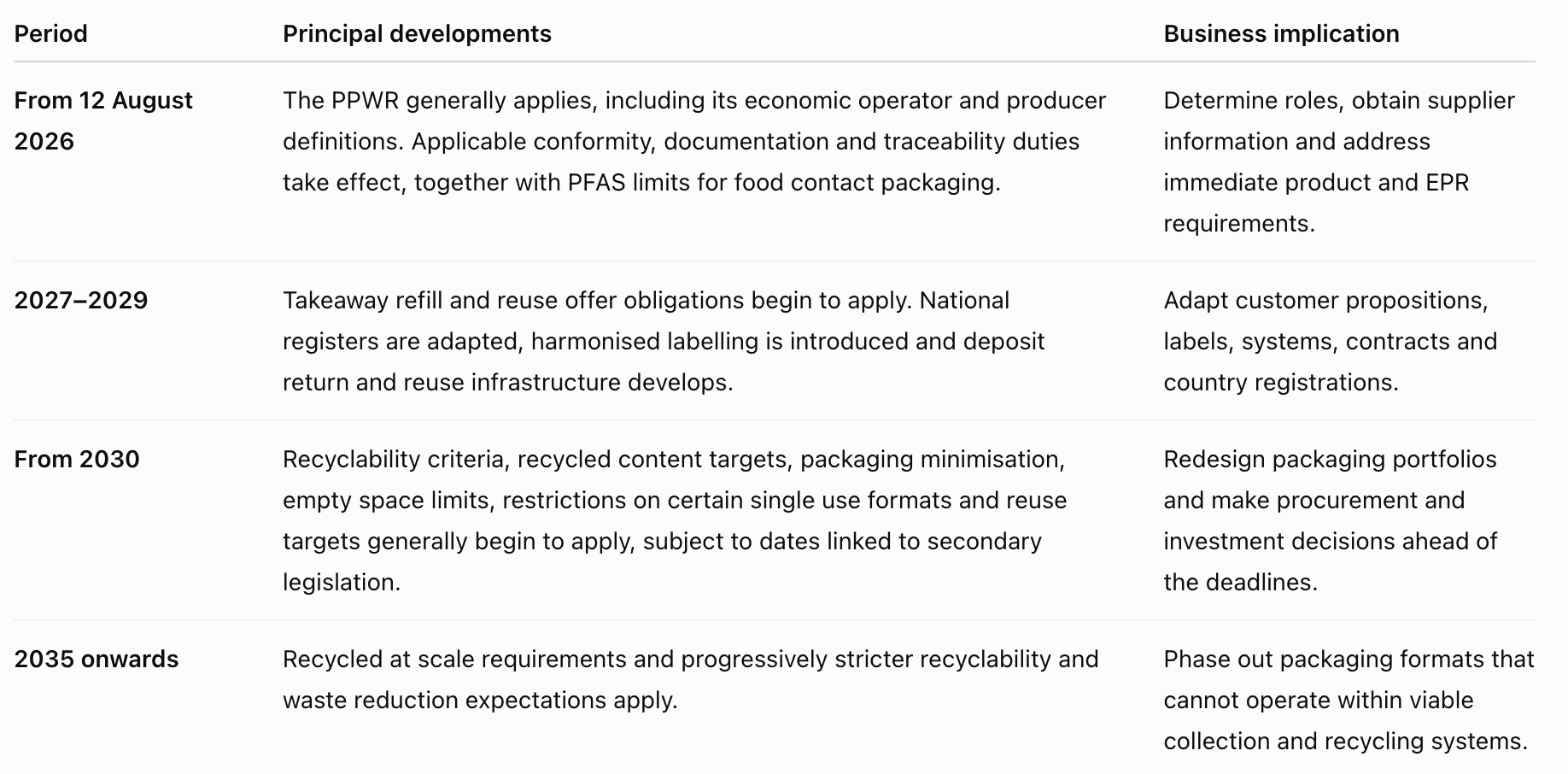
Later design deadlines should not be interpreted as permission to wait. Packaging specifications, supplier contracts, production tooling and product launches often run for several years. Packaging that will be placed on the market in 2030 may already be under development today.
Which sectors are most affected by the PPWR?
Although almost every product based business is affected, several sectors face particularly significant changes.
- Food, beverage and hospitality businesses face the immediate PFAS restriction for food contact packaging, followed by refill and reusable packaging requirements and restrictions on several single use formats.
- Retailers, consumer brands and private label businesses may qualify as manufacturers because their names or trademarks appear on packaging. This brings responsibility for conformity documentation alongside national EPR obligations.
- E-commerce businesses and online marketplaces face multi-country producer registrations, data requirements and future empty space limits. Online marketplaces must also verify the EPR registration of sellers offering packaged products to consumers.
- Industrial and B2B businesses should not assume that the PPWR is predominantly a consumer packaging regulation. Pallets, crates, drums, intermediate bulk containers, stretch wrap and straps are within scope and may be subject to reuse targets. Direct deliveries to professional end users can also create producer responsibility in the destination country.
Importers and non-EU groups face an additional challenge: they will need access to sufficiently detailed packaging and conformity information from overseas suppliers while determining which EU entities or authorised representatives carry the relevant responsibilities.
How can businesses prepare for PPWR compliance?
The PPWR is too broad to manage as an isolated annual reporting exercise, but no company needs to analyse every SKU in full technical detail on day one. In practice, implementation comes down to four questions every business can ask itself.
What packaging do we actually use? Look beyond the box the customer sees: labels, e-commerce bags, pallets, stretch wrap and other transport materials all count. Map where that packaging comes from, where it is filled and where it ends up as waste.
Who is responsible for it? Determine for each packaging flow who qualifies as the manufacturer and who as the EPR producer. Private label products, imports and cross-border sales deserve particular attention, because that is where responsibility most often shifts.
Where do our obligations arise? Establish in which countries registration, reporting and fee payment are required, and test existing registrations and threshold assumptions against the new definitions. Then close the gaps: amend registrations, appoint authorised representatives where needed and align supplier and distributor contracts with the outcome.
How do we keep it under control? Embed packaging data in a routine process that connects procurement, logistics and product development, and use that same process to prepare early for what follows: PFAS restrictions today, recyclability, recycled content and the 2030 design rules ahead.
The PPWR makes packaging a cross-functional business responsibility. Sustainability teams may coordinate the response, but the decisive information and actions sit across procurement, product development, operations, sales, logistics, finance and legal. The immediate priority is visibility: what packaging the company uses, how it moves through the market, who controls its design and where it becomes waste. Once that foundation exists, businesses can implement the correct registrations and reporting arrangements while preparing their packaging portfolios for the requirements that follow.
RSM is a thought leader in the field of supply chain management including international tax. We provide frequent insights through training and thought leadership, based on detailed knowledge of industry developments and practical application gained from working with our clients. RSM helps companies connect individual geopolitical and regulatory developments to the broader changes affecting their supply chains. By doing so, we support businesses in distinguishing short term disruption from structural change and translating that assessment into coordinated decisions on sourcing, origin, landed cost, logistics and supply chain design. If you would like to discuss what these connected developments mean for your business, please contact one of our consultants.
This publication is part of RSM's Voice of Supply Chain Management. Each month, RSM shares insights into global supply chain developments and translates their impact into practical considerations for internationally active companies.
