
 Linkedin

 Facebook
 Email
 more

This is a publication that is part of RSM's Voice of SCM. On a monthly basis, RSM issues the Voice of Supply Chain Management (SCM). Our consultants follow global developments and translate their impact into practical considerations for internationally active companies.
AI agents in tax could make research and scenario analysis more affordable, and the value then lies in bringing tax assessment closer to the business decisions that create obligations. That value depends on a supportable basis for each assessment, and a cheaper model does not by itself make the whole process cheaper. Tax departments are being asked to meet more requirements with fewer resources. Corporate income tax obligations are expanding, value added tax (VAT) is becoming more closely connected to transaction-level reporting, and payroll teams must assess working arrangements that cross borders. Group reporting requires information that often sits outside the tax department. Budgets rarely expand at the same pace.
This article was written by Mario van den Broek (MvdBroek@rsmnl.nl) and Mourad Seghir (MSeghir@rsmnl.nl). Mario and Mourad are consultants with RSM Netherlands with a focus on international tax, transfer pricing and tax technology.
At the same time, the technology available to Tax is changing. Releases such as GPT-6.1 Sol, Claude Opus 5.5 and new Chinese models, including DeepSeek-V4.1-Flash, come with developer-reported improvements in capability and cost efficiency.
Announced proactive agents such as Claude Duet and Dots point towards systems that can pursue tasks across connected applications, within defined permissions. Some remain in research preview. These developments could change the economics of the tax function. More research and scenario analysis may become affordable. Agents could reduce the effort needed to recognise a change, gather information and prepare the next step.
The value of that capacity depends on how it is used. A department can generate more analysis and still discover important tax consequences too late. Our view is that AI’s strategic contribution lies in bringing tax assessment closer to the business decisions that create obligations, while maintaining a supportable basis for those assessments.
How do better models change which questions are worth investigating?
When an analysis is expensive, Tax must ration attention. Statutory deadlines take priority, and issues with an obvious financial exposure receive specialist review. Smaller changes or less clearly defined opportunities may remain unexplored. Lower analytical costs can change that allocation. A corporate income tax team could examine alternative investment assumptions before a budget is approved, and a VAT team could look at the treatment of a proposed service before the sales process is configured. Payroll could assess a cross-border working arrangement while it is still being discussed. The same goes for transfer pricing scenarios during the design of an operating model, and for the information gaps that reporting teams could identify earlier in the close process. The change concerns the number of questions an organisation can reasonably investigate, and the stage at which it can investigate them. That can give management a wider view of the tax consequences of its options.
However, lower model costs do not automatically translate into lower total costs. Research must be checked, calculations validated and material facts established. More scenarios can also create more review work. AI can assist with that review, but the investment case must account for the complete process. The relevant measure is therefore the cost of completing an obligation or reaching a supportable decision, rather than the cost of generating a draft.
How can proactive AI agents in tax help when Tax receives information late?

Better models improve the work that can be done with available information. Proactive agents could help change how that information reaches Tax. Tax consequences arise in procurement and other supply chain management decisions, customer contracts, employee movements and changes to operations. Where the tax department learns about those events only through a periodic information request or financial close, its opportunity to influence the decision may already have passed.
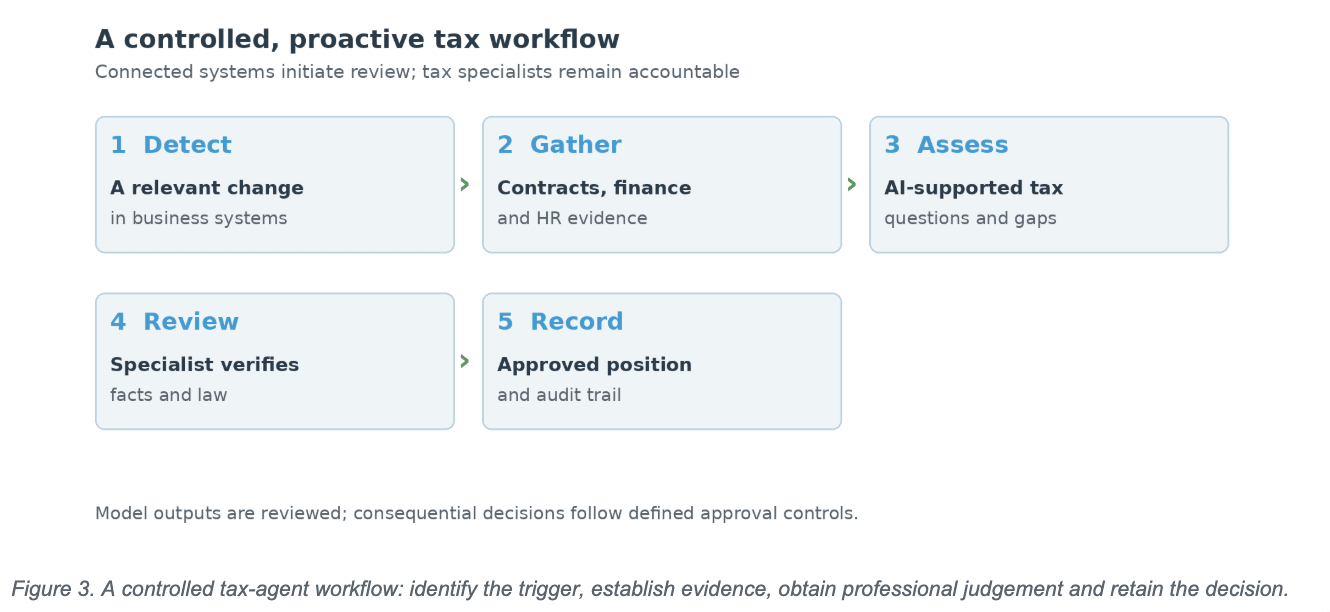
An agent-based workflow could, with appropriate access, follow defined events across finance, HR, contract-management and other systems. It could identify a relevant change, gather supporting records and prepare questions for review. For example, a new customer arrangement could initiate a VAT assessment, and a change in an employee’s working location could prompt payroll questions and a separate corporate tax review. An amendment to an intercompany agreement could trigger a transfer pricing assessment. A new reporting requirement could generate requests for information that is not yet captured in the group’s reporting process.
These are potential workflows requiring integration and testing, rather than capabilities a tax department can assume are ready simply because an agent product has been announced. Even so, Tax could become less dependent on someone remembering to notify it. Specialists could spend more of their time assessing the significance of a change and less time locating documents or chasing routine information. An agent cannot establish a fact that the organisation has never recorded. It can, however, identify the gap and direct a question to the person able to resolve it.
How can the same business decision affect several taxes, from VAT to transfer pricing?
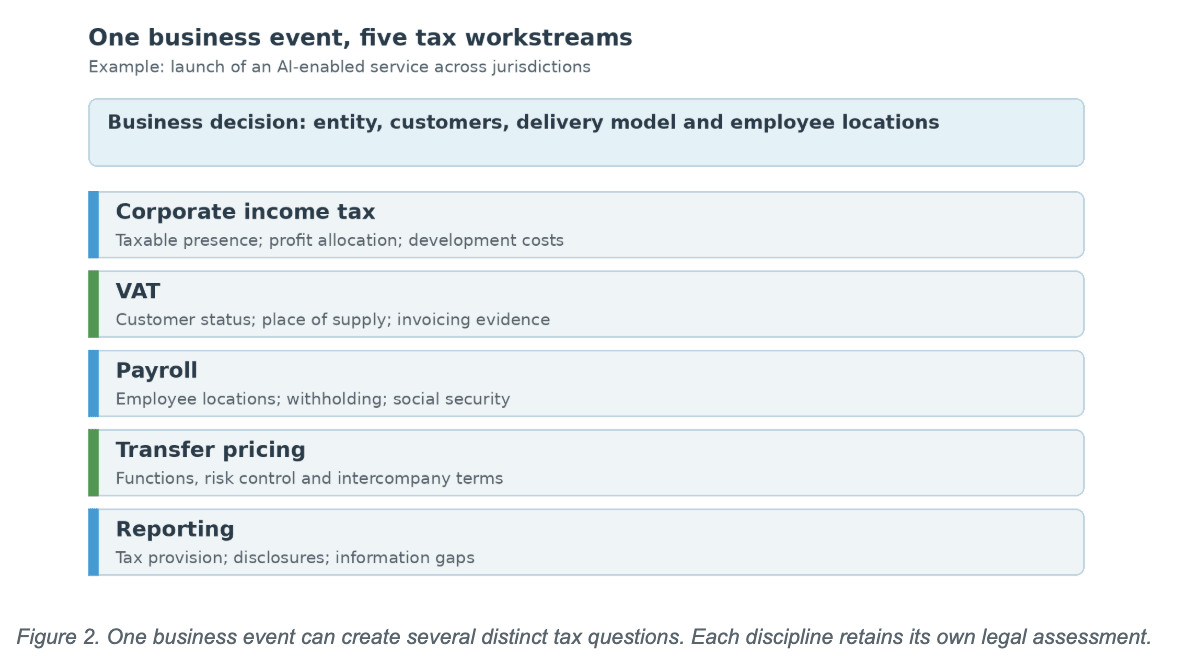
The combination of stronger models and proactive workflows creates an opportunity to connect tax disciplines around business events. Consider a hypothetical group, active in international trade, that introduces an AI-enabled service. The group must decide which entity contracts with customers, how delivery will be organised and where the supporting employees will work. Those decisions have implications across Tax.
For corporate income tax, the arrangements may raise questions about taxable presence, the allocation of taxable profits and the treatment of development expenditure. The tax treatment of those costs cannot simply be assumed to follow their accounting classification.
For VAT, the assessment needs to establish what is being supplied, the customer’s status and the applicable place-of-supply rules. Evidence supporting the treatment should be captured during customer onboarding and contracting. The development of e-invoicing and digital reporting, including the phased implementation of VAT in the Digital Age, makes the design of those transaction processes more important.
For payroll, employee locations and activities need to be assessed under the relevant withholding and social-security rules. Some of those facts may also matter for corporate tax, although the legal tests differ.
Transfer pricing needs to examine the contributions of the entities involved. Introducing a central AI platform may support local decision-making or accompany a genuine change in functions and risk control. Ownership of the technology alone does not determine the appropriate allocation of returns.
Reporting must reflect the resulting conclusions under the relevant accounting and disclosure requirements. Income-tax consequences feed into the tax provision; VAT and payroll obligations have their own accounting and reporting implications. AI can help analyse these consequences together. Each discipline still requires its own legal assessment. The advantage is that a material business change can become visible across Tax without several teams independently reconstructing the same facts. This is particularly relevant for new corporate tax reporting obligations, such as Global Anti-Base Erosion (GloBE) information reporting under Pillar Two, where applicable. Most of that work lies in locating information, establishing its reliability and understanding how it relates to the business, rather than in generating the reporting output.
Why does more scalable analysis make the quality of the question more important?
As AI becomes better at producing plausible analyses, the framing of the task gains importance. An instruction to assess the tax consequences of an AI rollout is too broad to review efficiently. A useful assessment needs to identify the proposed action, the relevant entities and jurisdictions, and the facts that could change the conclusion. It also needs room to recognise an issue that invalidates the original framing. Tax expertise and business context are both needed here. Accurate invoices do not establish who negotiated an arrangement, and a payroll record does not prove where work was performed. A contract does not necessarily reflect actual conduct. Several AI-generated analyses can be internally consistent because they all rely on the same outdated assumption.
Tax professionals need to determine which uncertainties matter and how they can be resolved. AI can propose interpretations, challenge reasoning and test sensitivity to assumptions. Professional review must establish which reasoning the organisation can support and adopt. Management’s risk appetite can inform choices among legally supportable options. It cannot remove statutory obligations or make an unsupported treatment acceptable. The resulting file should explain the material facts relied on and the legal reasoning applied. It should distinguish assumptions from established information, record the relevant approval and identify what would trigger reconsideration. An archive of prompts is not a substitute for that record.
How should a tax department use the capacity released by AI?
For a tax department under budget pressure, these developments present a management choice. Any capacity released could be used to absorb new compliance requirements, reduce expenditure or investigate business decisions earlier. If the saving is immediately removed from the budget, the department may have little additional capacity for advisory work. A greater strategic role requires an explicit decision to fund it. Technology adoption also needs resources. Integration, validation and training compete with current deadlines. Prioritising a bounded workflow can therefore be more useful than deploying several disconnected applications. Its value should be assessed across the whole process, including reviewer time and the rework caused by missing information. The organisation must also preserve the expertise required to challenge automated output. If routine work is removed from junior roles, alternative learning routes are needed. Otherwise, short-term efficiency could weaken future review capacity. The underlying model may change as new releases become available. Approved tax approaches should remain governed by the applicable law, verified facts and authorised decisions, with model changes tested before they influence the process.
For tax leaders, useful measures include the total effort required to complete a compliant process, the time between a business change and its tax assessment, and the ability to reconstruct why a position was adopted. These measures show whether cheaper production is creating sustained capacity. For the next investment or operating-model change, management should ask Tax to identify the consequences worth examining before approval and the evidence that must be captured during implementation. Stronger models can make that assessment more affordable. Proactive agents can help bring it forward. The organisation then needs to allocate enough expertise and authority for the assessment to influence the decision.
RSM is a thought leader in the field of supply chain management including international tax. We provide frequent insights through training and thought leadership, based on detailed knowledge of industry developments and practical application gained from working with our clients. RSM helps companies connect individual geopolitical and regulatory developments to the broader changes affecting their supply chains. By doing so, we support businesses in distinguishing short-term disruption from structural change and translating that assessment into coordinated decisions on sourcing, origin, landed cost, logistics and supply-chain design. If you would like to discuss what these connected developments mean for your business, please contact one of our consultants.
