
 Linkedin
 Facebook
 Email
Email more
more
Foreign ownership and operational control of European ports can affect supply chains even when a port remains fully operational. Changes in concessions, terminal operators, digital systems or access conditions may alter costs, contracts and routing options long before physical infrastructure is disrupted.
A port does not need to close for the supply chains that depend on it to be disrupted. A change in the legal basis, operator or commercial conditions can be enough to alter access, costs and contractual relationships, even while cargo continues to move.
The ports of Balboa and Cristóbal in Panama illustrate this distinction. At the end of January 2026, Panama’s Supreme Court declared the law approving CK Hutchison’s concessions for the ports unconstitutional. The ports remained open, but the arrangements governing their operation changed. Less than a month later, Panama authorised APMT Panamá and TIL Panamá to operate the ports under separate temporary concessions lasting up to 18 months.
The physical infrastructure remained in place, but the operators, legal basis and commercial counterparties changed. For companies using these ports, continuity therefore involved more than determining whether vessels could still call at the terminals. They also had to consider the consequences for existing contracts, access conditions, operating arrangements and longer term routing decisions.
This example is relevant to European supply chains because ports are not controlled through ownership alone. Concessions, terminal operations, carrier relationships, digital systems and inland connections can all influence how cargo moves through a port. A change in any of these elements can affect a route even when the port itself remains fully operational.
The purpose of examining foreign involvement in European ports is therefore not to treat every non-EU investor as a security threat. Foreign investment provides capital, capacity, automation and access to international shipping networks. The relevant question is whether one party can exercise material influence over a critical part of the route and whether the shipper has an alternative that does not depend on the same operator, carrier, system or infrastructure.
This article was written by Jaouad Bantal and Marius Ungureanu. Jaouad and Marius are consultants with RSM Netherlands with a focus on international trade and supply chain management.
How foreign ownership and control affect European ports
European governments are taking a closer look at foreign influence in critical port infrastructure. The debate is no longer limited to ownership stakes in ports. Increasing attention is being paid to operational control through terminal concessions, shipping networks, digital infrastructure and logistics connections. The concern is that strategic influence over trade flows may exist even where formal ownership is limited.
The complex ownership of port infrastructure
Ports rarely have a single, simple owner operator structure. A public authority may own the land and retain regulatory powers, while a private company holds a long term concession to operate an individual terminal. A minority shareholder may have no operational control, but it may also hold board seats, information rights, veto rights over reserved matters or commercial preferences linked to a shipping line. A majority investor may control the port company itself. At the same time, a technology provider can sit entirely outside the ownership chain while remaining indispensable to daily operations.
These positions are fundamentally different and must therefore be assessed separately. A shareholding alone does not demonstrate misconduct or an imminent threat to port operations. The examples below illustrate the different ways in which control, influence and operational dependence can arise. They do not constitute a blacklist or a ranking based on nationality.
This broader distinction between formal ownership and effective control is central to the debate about foreign involvement in European port infrastructure. Foreign participation can bring capital, capacity and stronger international connections, but it can also create strategic dependencies where investors, operators or service providers obtain influence over essential infrastructure and cargo flows. Chinese involvement has attracted particular attention within this wider debate because of the scale of its investment in European maritime infrastructure.
A 2023 study commissioned by the European Parliament’s Committee on Transport and Tourism identified 24 Chinese acquisitions and 13 announced greenfield projects in European maritime infrastructure between 2004 and 2021. The acquisitions exceeded EUR 9.1 billion, while the announced greenfield investments amounted to approximately EUR 1.1 billion. The study identified benefits such as capacity upgrades and improved connectivity, but also risks relating to strategic dependency, economic coercion, cybersecurity, data access and hard security. These figures provide a useful baseline for assessing the scale and nature of Chinese involvement, but they do not constitute a current or exhaustive register.
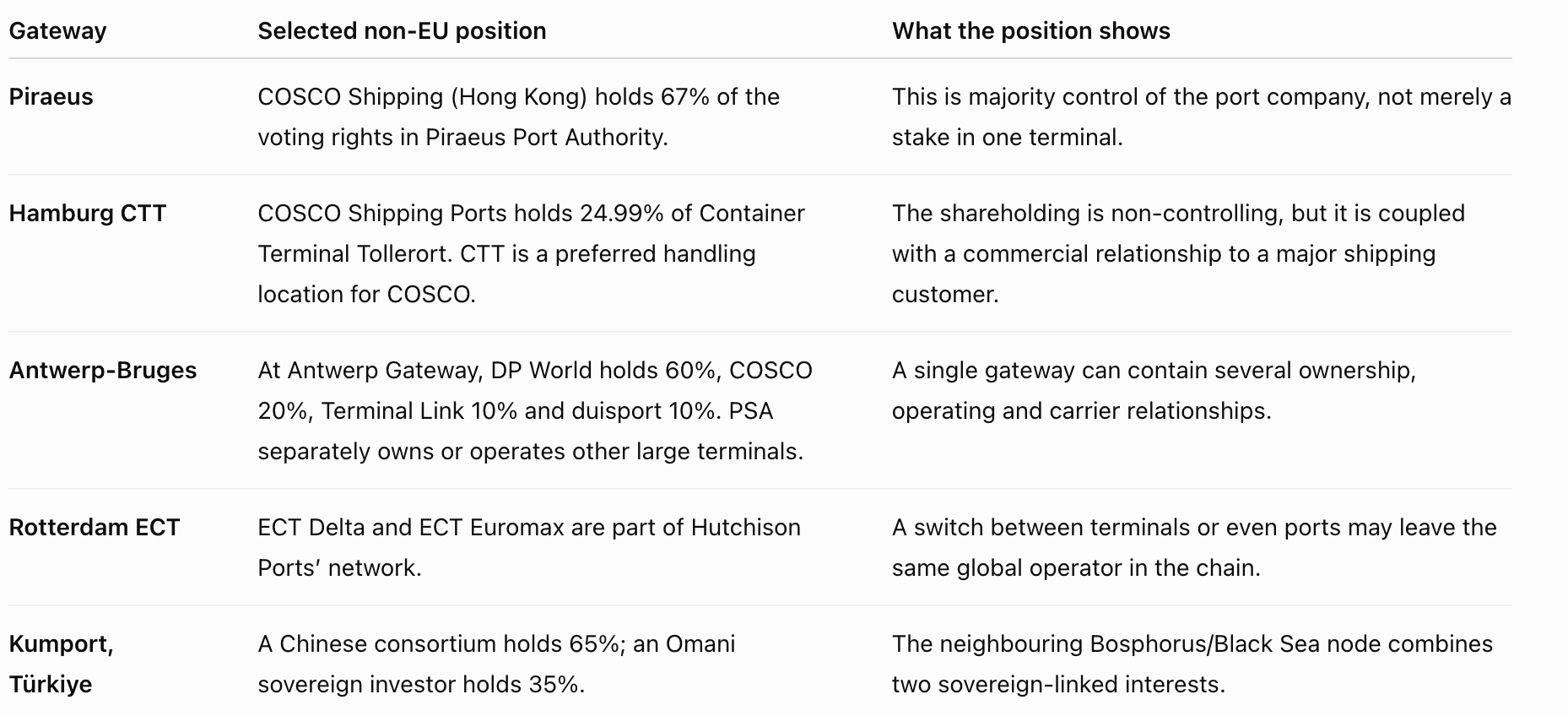
Two conclusions follow. First, the terminal or concession is usually the right unit of analysis, not the port name. Second, apparent diversification can disappear once the operator, carrier network, digital platform and hinterland corridor are added to the map. A company that names Rotterdam and Antwerp as alternatives may still be exposed to overlapping operators or carrier relationships.
The evidence also has limits. The European Parliament study covers investment through 2021 and calls for better data on software, data management and operational dependencies. Any company using it for a current route decision should therefore update the ownership and concession records rather than treating the study as a live register.
What Panama tells us about port control and supply chain risk
In March 2025, CK Hutchison announced two related in-principle transactions. One concerned its 90% interest in Panama Ports Company, which operated Balboa and Cristóbal. The other covered an 80% effective and controlling interest in companies owning, operating or developing 43 ports in 23 countries, together with management resources and terminal operating and IT systems. Neither transaction concerned ownership or operation of the Panama Canal itself.
That distinction did not keep the deal out of geopolitics. It became a point of open US-China contention: US officials framed the ports as a strategic concern, while China’s foreign ministry said it would defend the lawful interests of Chinese companies. After the Panamanian court ruling, the government used exceptional procedures to appoint temporary operators and preserve continuity.
The supply chain lesson is narrower, and more useful, than the political rhetoric. Cargo owners were not exposed because the canal suddenly became impassable. They were exposed because concession validity, counterparty continuity and future operating conditions became political variables. The same mechanism can appear through sanctions, investment screening, new licence conditions, cyber restrictions or emergency access rules. Physical closure is only the most visible form of disruption.
What does foreign control of European ports mean for supply chains?
The European Commission’s 2026 EU Ports Strategy reflects this broader view of control. It does not argue that all foreign capital is suspect. On the contrary, it says investment is welcome and needed. Its concern is source and influence, particularly where state-backed actors are involved or where a position creates technological lock-in, operational control or dependence on a high-risk supplier.
The Commission plans to develop guidance for Member States on assessing foreign investment in ports. The proposed approach would look at all relevant operators in critical supply chains and set thresholds and criteria for influence over strategic decisions, control of operations and dependence on high-risk equipment. A framework for mapping and monitoring foreign investment is intended to follow. In other words, the policy lens is shifting from the nationality written next to a shareholder to the rights and dependencies attached to the investment.
Digital infrastructure can create operational dependence
Digital control is part of the same analysis. The Strategy treats port digital systems, traffic-management tools and logistics platforms as strategic infrastructure. It notes that data exchanges can reveal commercially confidential information, that port activity often depends on foreign hardware and software, and that much EU port data is stored outside the Union.
For a cargo owner, the practical questions are who can see the data, where it is held, how access is logged and whether the information can be moved to another provider during an incident.
Military mobility may also affect port capacity
Military mobility introduces a different form of access risk. The Commission’s 2025 proposal is not yet a set of direct obligations for cargo owners, and that legal status should be stated plainly. If adopted in the proposed form, however, Article 21 would grant military transports priority access to ports and terminals while the European Military Mobility Enhanced Response System is activated.
Ongoing or planned civilian services could be interrupted, postponed or cancelled, without compensation from the armed forces to affected transport users. Article 38 would require Member States to maintain a last-resort framework for temporary control or a right of use over infrastructure, assets or equipment needed for military transport.
The Ports Strategy is likewise a policy communication rather than a new compliance regime for shippers. Its significance lies in direction of travel. Companies should expect closer investment screening, more security conditions in concessions and procurement, greater attention to high-risk technology, and circumstances in which civilian capacity may be compressed even though the port remains operational.
Four questions for reviewing port and supply chain risks
Are the alternatives genuinely independent?
Naming a second port is not diversification if the same terminal operator, carrier alliance, platform or inland bottleneck remains in the route. An alternative should be tested for available capacity, suitable equipment, customs connectivity and rail, barge or road access. A theoretical route is not a contingency until it has been operationally qualified.
Who can change the terminal, and on what terms?
Many cargo owners contract with a carrier or freight forwarder rather than with the terminal. Their leverage sits in tenders, routing instructions and service-level agreements.
Material contracts should address nominated terminals; notice and consent for substitution; priority or reserved capacity at another gateway; responsibility for rerouting, storage, demurrage and data-transfer costs; continuity after a change of operator or control; and access to operational information during an incident. A broad force-majeure clause does not allocate these decisions.
Can the data move with the cargo?
Port community and terminal systems may hold vessel schedules, container identifiers, customer and supplier details, cargo characteristics and movement patterns. Companies should identify the operator and subcontractors with access, the location of systems and cloud services, logging and incident-notification requirements, and the process for exporting data to another provider. Digital integration is valuable; captivity to an opaque system is not.
What happens when the port is open but capacity is unavailable?
Commercial and defence logistics may need the same berths, cranes, rail paths, storage areas and digital interfaces. Priority use, security restrictions or exercises can narrow civilian operating windows without causing a formal closure. Contingency models should therefore test reduced or delayed access, not only the loss of an entire gateway.
The depth of review should be proportionate. It matters most for high-volume shippers, regulated or critical cargo, time-sensitive production and companies concentrated in one terminal or carrier network. It may be less material where volumes are small, transport is genuinely fungible and several independent routes have proven capacity. Foreign investment often improves infrastructure, and even majority control can be manageable where governance is transparent, regulation is effective and substitutes are real.
The more credible risk scenario is cumulative. A foreign-controlled terminal may also be tied to one carrier network, one operating system and a constrained rail corridor. Add an investment-screening decision, cyber incident or military-priority request, and a route can become unusable faster than procurement can replace it.
That is why ownership intelligence belongs alongside sourcing, customs, cybersecurity, contracting and business continuity. The task is not to react to every port headline. It is to know which changes alter control, and whether the alternatives would still work when needed.
How should businesses prepare for changes in port control?
The next phase of European port policy is unlikely to produce a blanket restriction on non-EU investment. A more selective system is emerging. Transactions, concession renewals and major technology procurements will increasingly be examined for the influence they confer, not simply for the nationality or percentage shareholding of the investor.
Voting rights, access to operational information, dependence on a particular carrier and control of essential systems are likely to matter more than a company name in the shareholder register. The first effects may be administrative rather than physical. Investment reviews could take longer, concession agreements may carry additional security conditions, and port authorities may require clearer assurances on data storage, technology suppliers and operational continuity.
Implementation will not be uniform. Member States retain different ownership models, screening procedures and strategic priorities, which means that comparable investments may face different conditions in Rotterdam, Hamburg or Piraeus. For cargo owners, that regulatory fragmentation is itself a planning risk.
Digital infrastructure is likely to receive particularly close attention. Replacing a shareholder is legally difficult but technically possible; replacing a deeply embedded terminal operating system during an incident may be harder. As the EU develops its proposed monitoring framework, scrutiny is therefore likely to extend beyond terminal owners to software providers, cloud environments, traffic-management systems and the parties able to access commercially sensitive port data. Companies that cannot identify those dependencies will struggle to demonstrate that their alternative routes are genuinely independent.
Military mobility could create a different pressure. If the Commission’s proposal is adopted in its current form, military transports could receive priority access when the European Military Mobility Enhanced Response System is activated. Civilian services might then be delayed or displaced even while the relevant port remains operational. That would require contingency plans based on reduced capacity and longer dwell times, not only on complete port closure.
None of these developments makes disruption inevitable. They do, however, change when a company needs to act. Waiting for a port to close, an investment to be prohibited or a system to fail would leave little room to renegotiate contracts or qualify another route.
The more useful trigger is an earlier change in control: a concession renewal, acquisition, carrier-alliance decision, technology migration or new access condition. Those events should prompt a fresh review of who controls the route and whether the alternatives would still function under pressure.
The practical starting point is a short review of existing routings: map who controls each terminal, operator, carrier, digital system and inland leg; test whether the named alternatives are genuinely independent; and check what current contracts allow when control changes.
RSM is a thought leader in the field of supply chain management including international tax. We provide frequent insights through training and thought leadership, based on detailed knowledge of industry developments and practical application gained from working with our clients. RSM helps companies connect individual geopolitical and regulatory developments to the broader changes affecting their supply chains. By doing so, we support businesses in distinguishing short-term disruption from structural change and translating that assessment into coordinated decisions on sourcing, origin, landed cost, logistics and supply chain design. If you would like to discuss what these connected developments mean for your business, please contact one of our consultants.
This is a publication that is part of RSM’s the Voice of SCM. On a monthly basis, RSM issues the Voice of Supply Chain Management (SCM). Our SCM consultants constantly follow global SCM developments in an everchanging society and translate their impact into practical considerations for internationally active companies.
