
 Linkedin
 Facebook
 Email
Email more
more
RSM publishes the Voice of Supply Chain Management (SCM) each month. Our SCM consultants follow global developments and explain what they mean in practice for internationally active companies.
Transfer pricing (TP) is often treated as an annual compliance exercise. The same information about entities, transaction flows, contracts, functions, risks and payment terms can also support withholding tax (WHT), compliance, forecasting, customs and management decisions. AI and software can help connect this information, classify transactions, extract terms, flag anomalies and prepare supporting evidence. They can also run repeatable calculations. Tax professionals must still determine beneficial ownership, treaty entitlement, the character of a payment and whether the facts support an arm’s-length position. This article explores how to reuse TP data across the tax cycle and test the benefits through a focused prototype before committing to wider integration.
Beyond efficiency and compliance, AI-enabled transfer pricing platforms can also support treasury objectives by providing real-time visibility over profit allocation, funding requirements and cash generation across multinational groups, helping businesses optimise liquidity and capital allocation.
This article was written by Juan Dosal (JDosal@rsmnl.nl) and Mourad Seghir (MSeghir@rsmnl.nl). Juan and Mourad are consultants with RSM Netherlands with a focus on international tax, transfer pricing and tax technology.
Reusing transfer pricing data
Building a shared tax data layer
TP brings together information that other tax processes need: the entities and countries involved, transaction type, contract, calculation, amount and payment or adjustment date. It can also link ledger entries to invoices, agreements, budgets and documentation. These records are often scattered across ERP systems, payment tools, contracts, spreadsheets and local tax files. Re-entering data and using inconsistent descriptions can leave errors undetected until a true-up or audit. A useful starting point is a shared, controlled set of facts, with clear ownership, source version history and review points. Each tax process then applies its own rules. AI can help extract and classify information and prioritise issues for review; calculations follow defined rules, and tax professionals approve the conclusions.
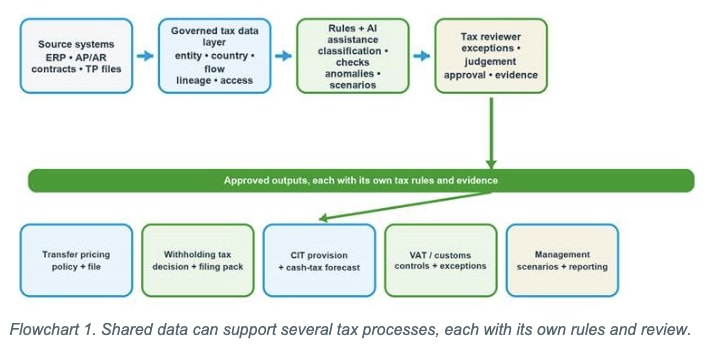
Where the same information adds value
TP data can support several tax processes. Each use case needs rules for the relevant jurisdictions and periods, data checks and a named approver.
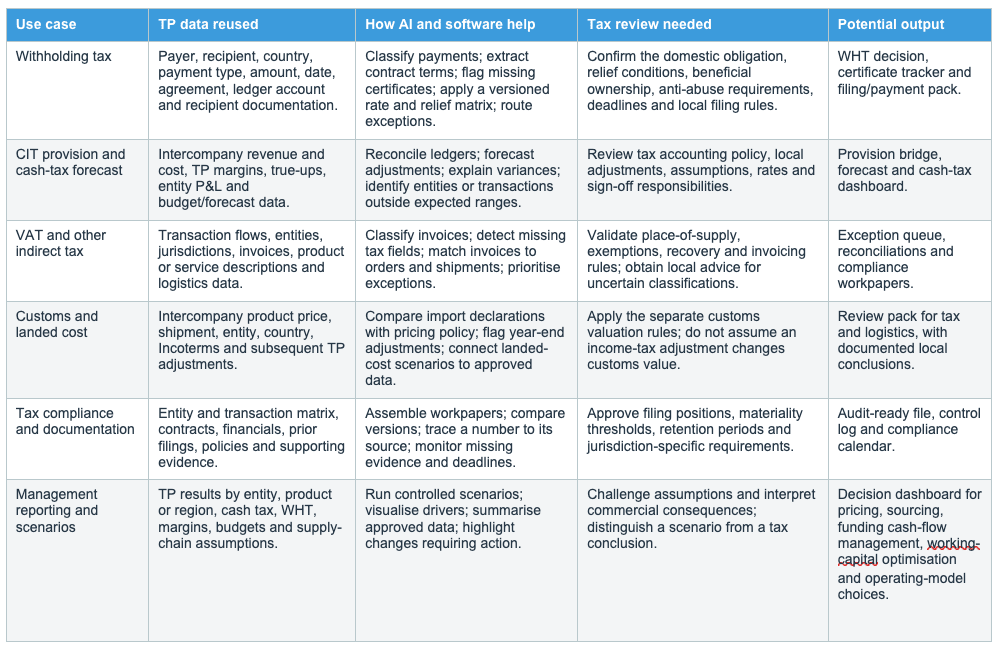
Responsibilities should be clear: the business owns operational facts, finance reconciles the ledger, tax approves legal rules and filing positions, and technology and security teams manage access and system resilience.
Withholding tax as a first extension
How transfer pricing data can support withholding tax reviews
Intercompany ledgers and agreements often contain the payer, recipient, payment type, country, amount and date needed for a WHT review. A platform can compare this information with approved rules and flag missing evidence. A tax professional must then confirm the domestic obligation, any relief and entitlement to it, anti-abuse conditions, required documents, deadlines and reclaims. Rates and conditions should reflect the relevant effective date and link to an authoritative tax source. An ERP label such as ‘service fee’ or ‘royalty’ does not necessarily determine the payment’s legal character. AI can suggest a classification from the agreement, but a tax professional should approve it and record the reasons.
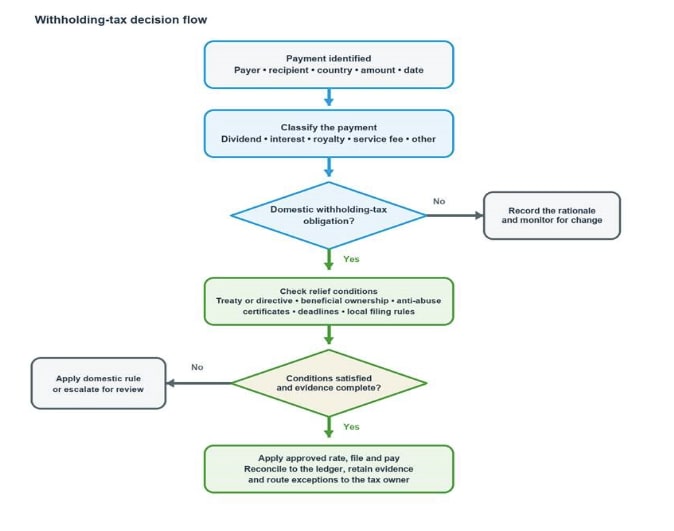
Flowchart 2. WHT review separates data preparation from legal approval and retains evidence for both.
Using tax data in business decisions
Using tax data earlier in the decision-making process
Connecting tax data to business decisions allows the team to assess a contract, payment, supply-chain change or funding decision before it is completed. A platform with appropriate controls can support that assessment throughout the year.
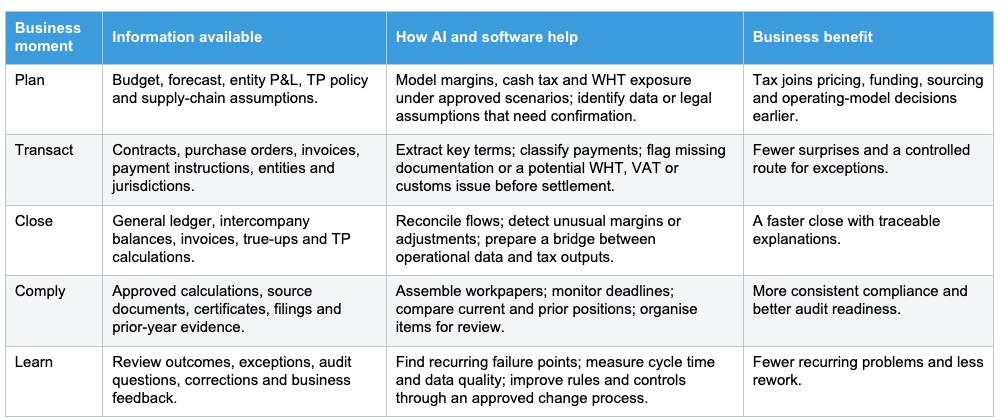
A sourcing change, intercompany service, financing arrangement or inventory model may affect TP, WHT, customs, VAT, cash tax and management reporting at the same time. A shared set of reliable facts helps tax contribute while the decision is being made.
Transfer pricing data, treasury and cash flow
Beyond compliance, automating transfer pricing policies and calculations through AI can also create significant treasury and cash-flow benefits. By monitoring intercompany transactions, profit allocation and transfer pricing outcomes in real time, companies can identify situations where existing transfer pricing policies result in cash being accumulated in entities that do not require it from a business perspective. In practice, a poorly calibrated transfer pricing model may trap liquidity within certain entities or jurisdictions while other group companies require funding, forcing treasury teams to obtain external financing despite excess cash being available elsewhere in the group. By combining transfer pricing, treasury, financial and operational data, AI-enabled platforms can provide near real-time visibility over profitability, funding needs and cash generation across the value chain, enabling CFOs to optimise working capital, reduce financing costs and allocate capital more efficiently. This transforms transfer pricing from a compliance requirement into a strategic tool that supports both tax governance and financial performance.
Controls needed before expansion
Separating automation from tax judgement
The system should separate repeatable calculations from interpretation and retain enough detail for a reviewer to reproduce the output: the data, rule version, model configuration, exceptions and approval.
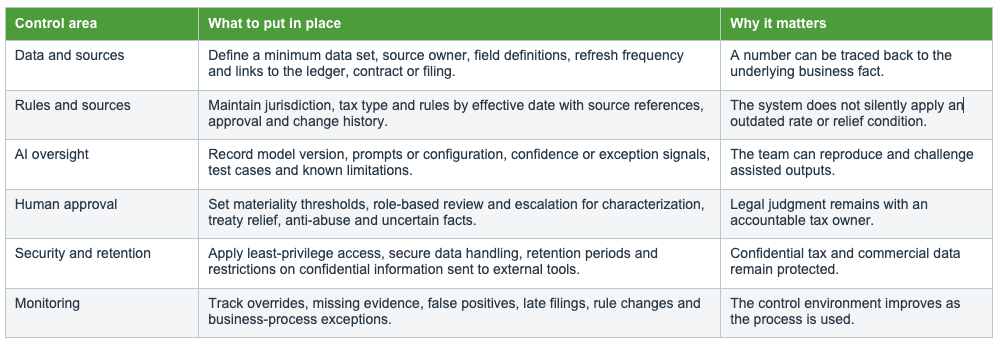
Where generative AI fits in the process
Generative AI is useful for extracting terms, comparing documents, explaining variances, suggesting categories and preparing drafts. Rates, thresholds, reconciliations, calculations and filing schedules are better handled by software that follows defined rules. Reviewers should be able to see which method produced each output.
Start with a focused pilot
Select one manageable intercompany flow, such as a service fee, financing payment, royalty or TP true-up. Map the process from start to finish, then test whether the same data can support WHT or another related tax process.
- Set the scope. Agree the entities, jurisdictions, systems, tax questions, owners and success measures. Keep the first test small enough to validate properly.
- Agree the data needed. Define the entity, counterparty, payment, contract, ledger, country, tax type, evidence and effective-date fields required for TP and the related process.
- Configure the rules and AI support. Use approved tax rules for calculations, with AI helping to extract and classify information, detect anomalies and prepare workpapers.
- Test known transactions. Re-run historical cases and reconcile the results to the ledger and prior filings. Record false positives, missing evidence and reviewer overrides.
- Test the dashboard and review process. Give tax, finance and the relevant business owner a shared view of inputs, results, exceptions, evidence and approvals.
- Decide whether to expand. Weigh the measured benefits against integration costs, governance needs and local-law requirements before adding jurisdictions or use cases.
Developing the platform further
This case draws on a confidential proposal, with names and identifying details omitted. It describes a proposed approach; the prototype had not yet produced results in a live operating environment.
Starting with a limited transfer pricing prototype
A client wanted to explore a platform for transfer pricing that could later support withholding tax and other tax and finance processes. A full transformation had not been budgeted, so the proposal began with a limited prototype to test the value before committing further. The first phase would review the available data, legal entities, transaction flows, accounting records, intercompany arrangements and compliance processes. Agreed business rules would then be built into a working calculation model. The design would also assess whether the same platform could support WHT, tax compliance and management reporting.
The proposed phases were a confidential basis for discussion. Hours and fees were provisional and subject to agreement. Any later investment in a production system would depend on the prototype’s results.
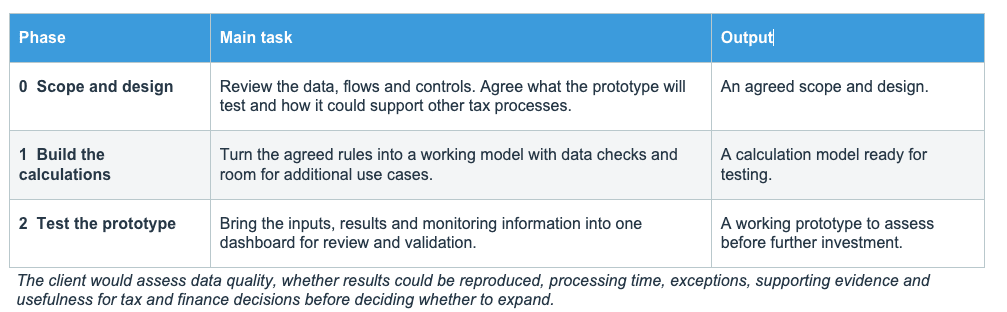
When to expand the platform
Further development could include ERP and payment integrations, jurisdiction-specific WHT rules, approval processes and monitoring of legal changes. The platform might also support tax provisions, VAT or management reporting. Starting with a familiar transaction gives the tax team a practical way to test how well the data, rules and review process work together. Any decision to expand should reflect both the time saved and the reliability of the results.
As organisations continue to integrate AI into their tax operating models, the opportunity extends beyond improving compliance efficiency. Transfer pricing policies directly influence how profits and cash are distributed throughout a multinational group. Enhanced visibility over these flows can help prevent cash from becoming trapped within the value chain, reduce unnecessary borrowing and strengthen coordination between tax, treasury and finance functions.
RSM advises on supply chain management, including international tax. Our training and publications draw on industry developments and practical client work. We help companies assess how geopolitical and regulatory changes affect their supply chains, distinguish short-term disruption from structural change, and coordinate decisions on sourcing, origin, landed cost, logistics and supply-chain design. Please contact one of our consultants to discuss the implications for your business.
