Linkedin
 Facebook
 Email
Email more
more


Australian manufacturers are being urged to embrace the ‘circular shift’, a fundamental rethink of how electronic products are designed, used and recovered.
With e-waste growing faster than any other waste stream, the industry faces mounting pressure to design for durability, repairability and end-of-life recovery.
ReSource, Australia’s largest e-waste recycling facility, is leading the charge with advanced technology and a commitment to circularity. By recovering valuable materials and extending product lifecycles, they help manufacturers meet ESG goals, reduce environmental impact and unlock new opportunities. As legislation tightens and consumer expectations rise, collaboration between manufacturers and recyclers will be key to creating regenerative systems that keep resources in play and position Australia as a leader in the circular economy.

Join Glyn Yates, Partner, RSM Australia and Troy Rowe, Founder, ReSource, as they explore the circular shift and why Australian manufacturers must rethink waste, reuse and recovery.
Troy Rowe: It’s massive! It’s a complete shake-up of the current system, where we take valuable resources from the earth and discard them without a thought for their future needs or value. Manufacturers need to carefully consider the materials they are using to make their products, design aspects beyond use-cycles (i.e., design for end-of-life), and how their customers can repair them when they break down. On top of making better products that last, this will also create trust in their offerings and lead to customer retention and business prosperity. Unfortunately for us, not a lot of e-product manufacturing takes place in Australia, and this also presents a challenge for industry-leading e-waste recyclers like us who are doing our utmost to rescue and recirculate as many of the valuable resources already in circulation as possible.
We aim to recirculate as many of the resources we recover in Australia; however, the reality is that we are forced to work with international partners and ship a lot of material offshore, where the bulk of manufacturing takes place.
Product as a service and share economy not mentioned here intentionally.
Troy Rowe: E-waste has been increasing at an alarming rate for decades—far faster than any other waste stream in Australia—and yet our national stewardship efforts remain limited to a handful of specific product categories. As most people should know by now, e-waste contains finite resources that we can’t make more of, and in some cases, toxic substances that have the real potential of causing harm to people and the planet.
We are losing valuable and critical raw materials to landfill faster than we can extract them, and urban mining through e-waste recycling has a much lower environmental toll, so it just makes sense. Responsible e-product lifecycle management is a great business strategy. If we keep managing our unwanted and end-of-life products poorly, we won’t have access to the critical resources we need in the future. A lot of the valuable resources within e-waste are crucial to fuel the global transition to renewable energy, and we can’t get there with endless conventional mining. Community awareness of the need for responsible lifecycle management of electronics is growing, and we’re seeing consumers increasingly call for better product design and simpler, more intuitive options for managing their pre-loved items responsibly.
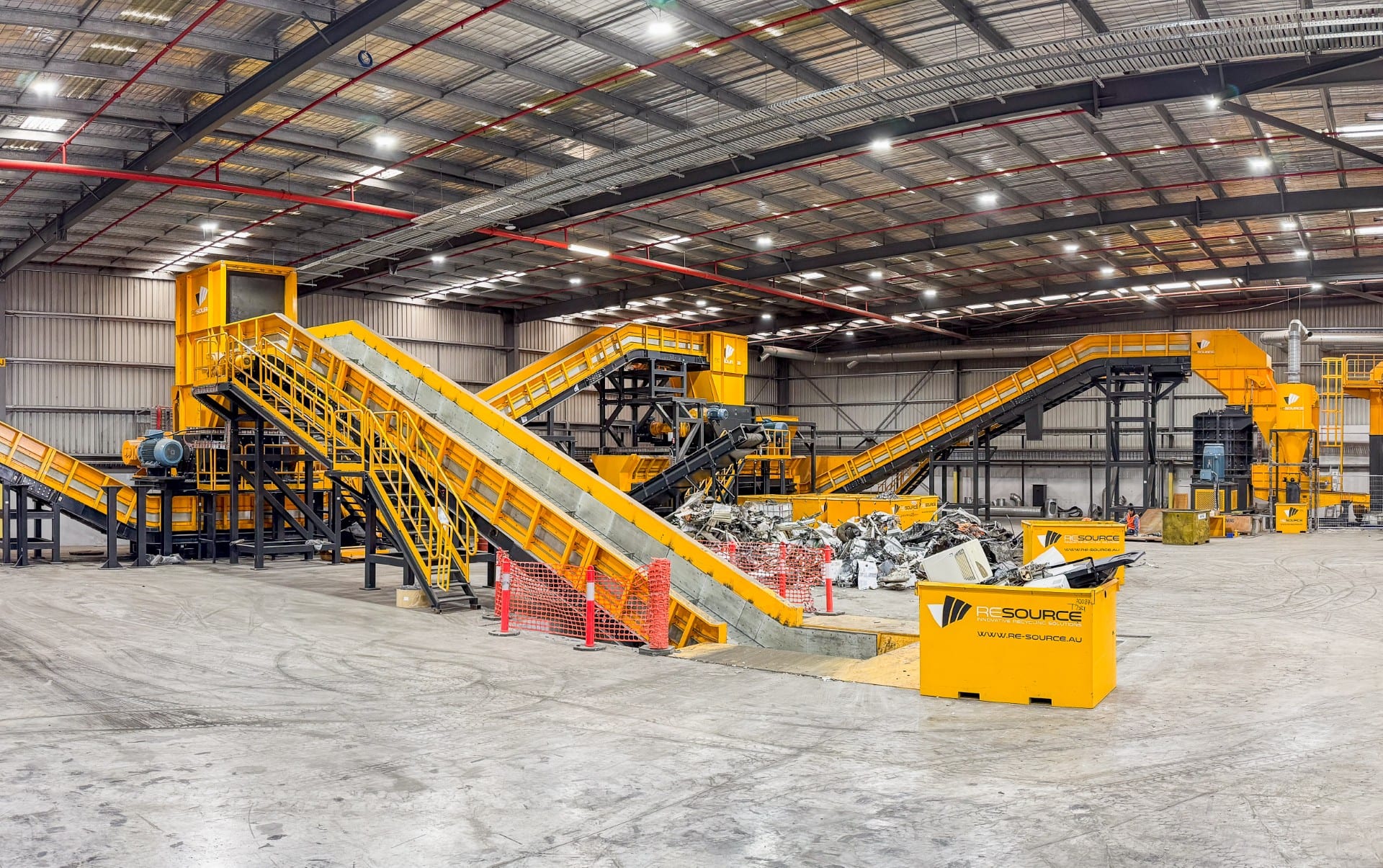
Troy Rowe: ReSource is home to Australia’s largest e-waste recycling facility – powered by an 860kw solar system that produces more renewable energy than our operations consume.
We use advanced processing technology to recover critical resources and extend e-product lifecycles – our clients trust us to keep their products and materials circulating at their highest values, for as long as possible.
We have a strong compliance focus and are committed to implementing innovative approaches to e-waste recycling that support us in achieving the best environmental and resource recovery outcomes.
We provide our clients and customers with clear downstream traceability, so they know what’s happening to their assets, and we can transparently report on verifiable outcomes with confidence.
Our services range from collection equipment hire and transport logistics to recycling and IT asset disposition (ITAD). Through ITAD, we can redirect devices from premature recycling into reuse, helping to bridge the digital divide and improve access to affordable IT for Australians who cannot afford new devices.
Troy Rowe: The term ‘e-waste’ extends to every device and piece of equipment that requires a power source to operate – anything with a plug or battery. There are literally hundreds and thousands of products that meet this description. As you could imagine, there is a significant variation in the products we responsibly recycle for our clients – everything from the beloved family fridge at home to the mobile phone or alarm clock that gets you out of bed every morning. We offer industry-leading recycling capabilities across all e-waste categories and have an installed processing capacity of 20 kt per annum, exceeding that of any other e-waste recycling facility in Australia.
Troy Rowe: The ReSource facility is home to many firsts in Australia:
- First net negative energy impact recycling facility,
- First X-ray sorter for mixed batteries in the southern hemisphere,
- First and only facility to process temperature exchange devices in an environmentally responsible way; and
- First to have a fleet of vehicles and equipment with a minimum Euro 5 emissions rating.
From day one, we chose the difficult path to launch a facility that delivered the scale we knew we required to efficiently process e-waste. How big? Our facility remains the largest e-waste processing facility in the Southern Hemisphere and, as far as we are aware, is home to the world's most powerful e-waste processing line. It is this scale and this power that enable us to operate at some of the highest productivity rates in the industry, globally, and far above any other solution in Australia.
Time and time again, it has been proven that manual processing and low productivity companies do not survive in the Australian marketplace.
We are grateful to have been awarded multiple Sustainability Victoria grants, which have supported the development of the infrastructure necessary to scale our operations and establish a sustainable, profitable business model.
The Australian Council of Recycling (ACOR) states that Australia’s recycling industry is one of our country’s growth industries, supporting a more sustainable economy, while directly employing over 20,000 people and indirectly creating almost 35,000 jobs.
ACOR estimated direct Full Time Equivalent (‘FTE’) employment per 10,000 tonnes of waste is 9.2 for recycling and only 2.8 for landfill disposal.
Troy Rowe: There are many advantages to recycling rather than sending materials to landfill, and for manufacturers, some of the most significant include protecting their brand and meeting—and even exceeding—their ESG goals and commitments. No producer wants to see their branded product ending up in developing nations where they lack the infrastructure, basic controls, and training to manage e-products safely and in an environmentally sound manner.
Plus, there are growing expectations (and laws) from consumers and government agencies across the globe for brands to directly address the negative lifecycle impacts of their products and the market externalities that have been running rampant for too long.
Producers also need access to finite resources to make the products we love, and with a continuation of the status quo, the clock will continue to tick, and time will eventually run out.
Troy Rowe: 100%. One of my favourite parts of our work is bringing manufacturers to our facility and seeing their faces when they first experience our equipment and processes. That’s where the penny drops and is often a light bulb moment where the problem they once saw turns into a major opportunity that excites them.
We are working closely with our clients from early in the design phase to investigate how we can bring the outputs of our recycling process directly back into supply cycles for new products.
Initiatives like ReMade in Australia will help to create demand for recycled content in new products, and that material will likely need to be sourced locally in Australia to meet relevant criteria (criteria still in development).
Troy Rowe: For years, Bunnings relied on a waste management company to recycle its consumer returns. That provider used a manual sorting process, then sent the sorted materials to a scrap metal company, which could only recover the steel.
Switching to ReSource has delivered both improved financial outcomes for Bunnings and substantially higher recycling rates. ReSource recovers not only all metals but also a significant portion of plastics, resulting in a markedly reduced environmental footprint for managing their consumer returns.
Troy Rowe: Secure data management and erasure are critical parts of decommissioning outdated or redundant IT equipment, and they often pose significant barriers to reuse or recycling.
Furthermore, it is essential to work with partners like us who maintain the highest industry standards, independently certified by accredited bodies, to ensure all service provider claims stand up to scrutiny.
Without proper testing to verify equipment safety and performance, products will continue to move down the waste hierarchy into lower-value recovery options.
Ruse remains an untapped tool in Australia’s product stewardship toolbox at present, and we will fall behind our international counterparts if our policymakers don’t address this soon.

Troy Rowe: Absolutely! Next week, Sustainability Victoria will announce that ReSource has been awarded a $1m grant to install Australia’s first AI-powered e-plastics sorting line. This technology didn’t even exist two years ago, but thanks to advances in AI processing power and machine learning, we can now combine data from four highly specialised sensors and interpret it within a millisecond to determine the type, colour, shape, and size of each piece of e-plastic. And this is only the beginning. Following a trip to the US in October 2025, what stood out was the increasing use of robotics. It is not completely clear today what that will look like across the e-waste sector but it is clear that there will be a significant impact.
Troy Rowe: A lack of legislation mandating responsible stewardship remains a significant barrier, and meaningful industry-wide progress often requires a regulatory ‘stick’ from government.
There will always be proactive manufacturers who aim to lead and pursue the best solutions, but others will lag behind until they are required to act. Education and awareness of the recycling technologies and services already available are also lacking, and often manufacturers simply aren’t aware of the fit-for-purpose solutions right in front of them.
Troy Rowe: By getting in touch with us! The ReSource team has extensive knowledge and experience in take-back initiatives and circular system design across a wide range of products and materials. We need to open the lines of communication between manufacturers and recyclers and create meaningful dialogue so we can work collaboratively to flip the current system on its head and tie the two ends together to create truly regenerative loops. As they say – you can’t dig yourself out of a hole, and you can go further and faster together than alone… We are here to help and serve manufacturers wanting to do the right thing, and sometimes the best way to get started is dipping your toe in the water and testing what success could look like via pilots and trials.
We are passionate about supporting manufacturers of all kinds on their journey toward circularity, and we encourage anyone who wants to do more—but isn’t sure where to start—to get in touch and begin the conversation with us today.
Troy Rowe: Legislation, legislation, legislation… We’re seeing strong momentum from progressive states like NSW, VIC, and SA, which are introducing state-based regulated e-product stewardship schemes that will place legal obligations on manufacturers selling products in the Australian market. Although we endorse stewardship measures of all kinds, including e-waste landfill bans, these bans must be accompanied by a coherent implementation plan. We urge caution regarding fragmented state-by-state approaches that may confuse the public and result in e-waste—and its valuable embedded materials—still being lost to landfill.
We will also see greater investment in innovative recycling operations capable of addressing e-waste at an industrial scale, along with more purpose-built infrastructure like ours established across every state to overcome Australia’s tyranny of distance. Treating e-waste as close as possible to its point of generation is always best, and ReSource is committed to expanding our service capabilities and processing capacity across all major states and territories.
Troy Rowe: ReSource has invested considerable time, effort, and money to bring innovative solutions to Australian shores that improve our capability to recover and recirculate critical raw materials at scale.
We have the capability to recycle almost any product or device that requires power to operate. The reality is that the same materials used to make a computer are also found in a stereo system or DVD player. Yet, these product categories still lack broad, convenient, and nationally consistent stewardship services.
Onshore recycling infrastructure is not a blocker to an Australian product stewardship scheme for all e-products – we have invested in the solution, and the legislation is out of step with current market capabilities. We call on stewardship policy makers and Federal government officials to work with progressive states like VIC, NSW, and SA to ensure Australia does not fall behind our global partners in the OECD. We have the solution – let’s not waste it or delay genuine circular action any further!
The scale of Australia’s e waste challenge is enormous, and businesses like ReSource sit at the centre of the solution. Troy and his team demonstrate what is possible when innovation, scale and sustainability come together in a single operation.
To support businesses like this, we need committed founders supported by investors who understand the potential of this sector and can help unlock the scale required. The circular economy is becoming one of Australia’s most compelling growth industries. If you are interested in exploring investment opportunities in this space, please get in touch.
FOR MORE INFORMATION
If you would like to discuss anything mentioned in this article, reach out to your local RSM adviser.
This article was originally posted in Manufacturing Monthly.