


What we’re hearing:
Farming has always required resilience. What’s changed is the number of risks converging at the same time.
Across the farm gate, uncertainty is becoming harder to isolate to any one issue. Fuel supply and cost, fertiliser pricing, labour shortages, climate events, machinery costs, succession planning, cyber risk, and financing pressure are all converging.
For many producers, decisions are now being made amid overlapping pressures that can change quickly and at the same time.
Diesel and fertiliser remain front of mind across much of the sector. Farmers continue to monitor global supply conditions closely, particularly around Middle East instability and its potential long term impacts on fuel and freight markets. Synthetic fertiliser also remains highly exposed to global energy and petrochemical supply chains, particularly nitrogen-based products such as urea.
With input costs rising and fluctuating crop prices, the imbalance has forced producers to think differently about how they manage risk and position their operations for long term resilience.
Tim Linke

“Scenario modelling has been especially important to help our farmers get through this difficult time. Be it the expected yield on a crop when worst case input scenarios are considered, or the viability of pre-purchasing and storing large amounts of fuel or fertiliser, this foresight is helping them make informed decisions in an otherwise very uncertain environment.”
Input costs are driving farm decisions
Diesel and fertiliser costs are now influencing farm decisions well beyond budgeting alone.
Many crop producers are now reassessing:
- crop selection
- nitrogen application strategies
- planting programs
- storage requirements
- timing of purchases
- alternate supply chains
Some growers are revising parts of their cropping programs toward legumes or rotational crops that require lower nitrogen input, while others are sourcing alternative nitrogen products or securing supply earlier to reduce exposure to shortages later in the season.
The risks are three-fold: uncertainty around supply access, inflated pricing, and difficulty offsetting higher costs through commodity prices. During previous fertiliser spikes, elevated grain and commodity values generally helped to absorb elevated expenses. Over the past two years however, wheat prices have softened significantly from the highs seen during the global supply disruption of 2022–2023. Fortunately, market conditions do appear to be improving. Australian wheat prices, for example, recently reached multi-month highs as a result of the current pressures.
Compounding the challenge is the rapid escalation in machinery costs. Large harvesters, cotton pickers, and specialised equipment can now cost well into the millions of dollars – driven by rising manufacturing costs, technology integration, and ongoing demand for larger and more efficient machinery.

As uncertainty and volatility continue across the sector, scenario modelling has become an invaluable tool to help farmers make more informed decisions around input costs, expected yields, commodity pricing, fuel exposure, seasonal conditions, investments, and cash flow outcomes.
Resilience starts on the farm itself

Historically, automation was often only commercially viable for major operators. Now, smaller and mid-sized operators are able to access these tools to help manage ongoing labour pressure.
One of the most notable changes emerging across the sector is the growing focus on self-sufficiency.
During COVID-19, many producers experienced firsthand how quickly supply chains could become stretched. That experience has continued to shape how they approach fuel and fertiliser security. Across parts of the sector, some farmers have expanded on-farm diesel storage capacity to allow them to hold months of fuel supply ahead of seeding or harvest periods.
Additionally, awareness around dependence on any one upstream or downstream provider – as well as overreliance on manual labour – is prompting farmers to reassess how they operate and influencing a wider range of farm-level decisions.
Many producers still struggle to secure reliable labour during critical periods such as seeding and harvest, and for livestock management. That pressure is accelerating investment in automation, robotics and precision agriculture, with producers increasingly adopting:
- autonomous machinery
- robotic dairies
- GPS-guided equipment
- automated livestock systems
- drone spraying technology
- precision application systems
These adoptions are in turn reducing manual workloads, lowering safety risks, and improving production visibility and throughput.
Productivity and sustainability are increasingly aligned
Across the farm gate, productivity gains and sustainability outcomes are more often working hand in hand. Rather than operating as separate priorities, many farmers are now approaching efficiency, cost management and emissions reduction as interconnected parts of the same challenge.
Precision agriculture technologies are playing a major role in that shift. Variable rate application, soil monitoring, GPS-guided equipment, and water management systems are allowing producers to:
- apply inputs more accurately
- reduce waste
- improve yield consistency
- lower fuel, fertiliser and water usage
In many cases, the commercial benefit comes first through better productivity and tighter cost control, while sustainability outcomes follow through lower emissions intensity and more efficient resource use.
Similar thinking is emerging in circular economy practices. Producers are exploring ways to reduce waste, improve reuse of organic materials, recover value from by-products, and extend the productive life of equipment and infrastructure. In an environment of rising input costs and margin pressure, these approaches are practical business decisions as much as sustainability initiatives.
Carbon farming and emissions reduction projects appear to be moving away from the “pioneer phase” and into the “compliance phase”, with greenhouse gas emission (GGE) reporting more relevant across the supply chain – particularly for producers supplying into larger processors, exporters and retailers subject to mandatory climate reporting obligations.

While many farm businesses may not be required to report, larger organisations will begin seeking emissions and operational data from their suppliers to support Scope 3 emissions reporting and broader sustainability commitments. This is placing more focus on data quality, traceability, record keeping, fertiliser use, fuel consumption, livestock emissions, and wider production practices. The ability to provide accurate information to relevant third parties will become essential as procurement expectations evolve.
Succession, scale and the future of farming
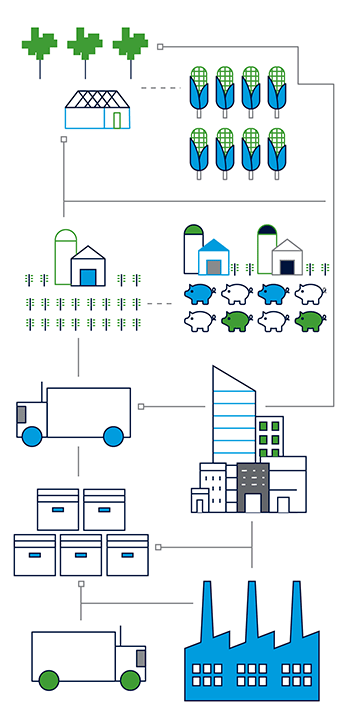
Across the sector itself, broader structural change continues. Large corporates, investment groups, and expanding operators remain active buyers of farming land in some regions, while urban expansion and environmental regulation are placing added pressure on land availability and land use flexibility.
Succession remains one of the sector’s most emotionally and financially complex challenges.
Rising land values and operating expenses are making it increasingly difficult for younger generations to take over farming businesses while fairly balancing outcomes for off-farm family members. The issue isn’t always the asset value, but whether the debt can be serviced by younger generations. For example, a farm may hold significant land value, while still being difficult to transfer without creating unsustainable debt pressure.
Trust structures remain a highly useful strategy in many succession scenarios, particularly where families are looking to:
- separate asset ownership from day-to-day business operations
- create greater flexibility around income distribution
- support gradual transition arrangements over time
However, proposed taxation changes announced in the 2026–27 Federal Budget may alter how some of these structures operate in practice. From 1 July 2028, a minimum 30% tax on trust income will apply, with a carve-out for primary production income.
While the exemption is important for farming operations themselves, many agricultural groups use multiple trusts for asset protection and succession planning purposes. Where these trusts lease property to related trading entities, net rental income will be taxed at 30% which reduces the efficiency of these structures and increases overall tax exposure.
Those that operate through companies will, however, benefit from the reintroduction of loss carry back measures. Losses incurred in the 2026-27 income year can be carried back up to two years earlier, to generate refunds of tax previously paid. This delivers a direct cash flow benefit during downturns and helps offset the impact of seasonal volatility.
Additional complexity emerges through proposed capital gains tax changes affecting pre-CGT farmland. Farmland acquired before 20 September 1985 will have its cost base reset to market value at 30 June 2027, exposing future capital growth to CGT from the 2027–28 income year. This will likely affect succession planning considerations around ownership structures, transfer timing, and management of future gains.
Beyond ownership and tax considerations, we continue to see farming businesses explore new ways to manage succession challenges. For example, carbon farming initiatives have provided some farming businesses with additional income streams, which can support succession planning by helping to provide for off-farm family members and creating more flexibility around wealth distribution.
Cyber risk is becoming a production risk
As farms modernise and increasingly leverage technology to support operations, the growing risk of cybersecurity incidents cannot be ignored.
Put simply, any device – from machinery to irrigation systems, livestock monitoring systems, accounting or procurement software – connected to the internet can present a risk. Recent examples include harvesters and tractors being remotely disabled, and a ransomware attack on a large processor’s system leading to cancelled shipments, producer hardships, and market volatility for livestock producers.
Some of the risks include:
- ransomware
- fake invoice scams
- compromised supplier communications
- hacked IoT devices
- locked operational systems
There are several steps farm owners can take to protect themselves. While working with a cybersecurity specialist to identify and address security gaps is ideal, basic do-it-yourself protections are helpful – such as multi-factor authentication, regular backups, invoice verification, software updates, and ongoing employee awareness.

Outlook
Australian agriculture continues to hold significant long term strengths around food quality, land capability, innovation and export competitiveness. 
Yet producers are operating in a more complex environment than many have faced historically. These factors are affecting how farming businesses assess risk and make investment decisions. The farm gate businesses likely to perform best in the coming years may not simply be the largest or most technologically advanced.
They are more likely to be those capable of combining adaptability, operational discipline, productivity, and resilience in an environment where volatility increasingly sits alongside opportunity.
CONTACT US
CONTACT US