


What we’re hearing:
Freight networks are carrying pressure from across the supply chain
Operating on the frontline of fuel shortages and price hikes, it is little wonder that transport companies are feeling the pinch right now.
From basic requirements to run and service a fleet, to unexpected weather events, persistent driver shortages, and increasing scrutiny around greenhouse gas emissions, logistics and freight operators certainly face a challenging road ahead.
At the same time, expectations from customers continue to rise. Together, this creates a difficult balancing act for operators trying to protect margins without compromising service standards.
Successful transport companies are quickly shifting from crisis mode to discipline mode, as average profit margins in road freight hover at just over 2%. The difference between success and failure will likely come down to how aggressively a company can use its data to manage its three biggest challenges: costs, labour and emissions reduction.
Jacob Elkhishin

“Large companies moving through mandatory climate reporting are increasingly looking at transport and freight emissions across their supply chains. As Scope 3 reporting expands, logistics providers may face growing requests for better emissions visibility and transport data.”
Freight networks carry more than product
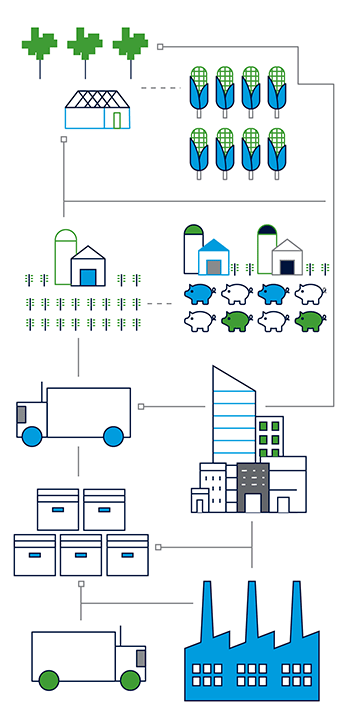
Freight networks underpin the movement of inputs and outputs across the entire agribusiness supply chain. This makes logistics and freight operators critical to both domestic supply continuity and export performance.
As the dominant mode of transport for moving non-bulk freight across Australia, road transport continues to carry the vast majority of agricultural and food products between farms, processors, ports, distribution centres and retailers.
Beyond domestic freight movement, international logistics networks play a vital role in supporting agricultural exports, although they remain exposed to ongoing volatility. While sea freight costs have moderated from the extreme highs seen during the pandemic, pricing and availability are still vulnerable. In the air, concerns around jet fuel pricing and availability may affect freight capacity and costs, particularly for premium export products reliant on rapid delivery.
Temperature-sensitive transport is also becoming a larger focus area, with cold chain logistics expected to grow steadily due to rising demand for fresh food delivery, premium perishables and live seafood exports. This is increasing the importance of chain-of-custody assurance, temperature integrity, compliance oversight and real time tracking throughout the transport journey. As a result, monitoring and tracking technologies are quickly becoming standard requirements in high value food export markets rather than optional capabilities.
Throughout the logistics and freight sector, operators are starting to prioritise clearer business-wide oversight. Many still manage scheduling, fleet management, maintenance, compliance, reporting and finance across disconnected systems, often with significant manual handling between them. As business demands increase, ERP platforms, transport management systems, telematics and fleet tracking tools are becoming more important for bringing this information together in real time.
The key priority is being able to make faster, better decisions. Operators want more insight into business performance and demand patterns so they can allocate resources more effectively and respond faster to disruption.
Workforce shortages continue to strain operations

Driver shortages remain a persistent structural challenge in the freight and logistics sector, particularly in regional areas, due to:
- competition for skilled labour
- ageing workforces
- retention and lifestyle challenges
These workforce challenges are unfolding against a backdrop of rising customer expectations around delivery speed and visibility – while operators also contend with higher fuel costs, insurance premiums, maintenance expenses, financing pressure and growing compliance requirements.
For smaller operators and subcontractors, these conditions are particularly difficult where margins are already tight or fleets require replacement and upgrading. Even large-scale logistics networks are exposed as business closure rates reach record highs, placing additional strain on supply chain capacity.
To help combat the driver shortage, some transport and logistics companies are employing strategies such as:
- Moving from long-haul models to hub-and-spoke networks so drivers can complete a shift and return home daily.
- Seeking to implement competency-based licensing to provide a clear career path rather than forcing new drivers to wait years to gain experience.
- Ramping up recruitment drives for women, who currently make up only about 3% of the driving workforce.
- Implementing electronic work diaries to reduce paperwork burden and installing better in-vehicle tech to make the job safer and less mentally draining.
- Offering retention bonuses and structured rosters to better compete with the mining and construction sectors that traditionally poach their best talent.
Financial pressure and consolidation
As financial pressure and the risk of debt default increases, banks and lenders are applying greater scrutiny to transport and logistics operators.
Businesses are being asked to provide more financial transparency supported by reliable operational data, budgets, forecasts and scenario modelling that demonstrate ongoing viability. Investing in this type of reporting capability can also improve access to capital for major expenses such as fleet upgrades and repairs. Additionally, scenario modelling helps businesses evaluate investment decisions and validate contingency plans should fuel conditions deteriorate further.
With the gap between stronger and weaker operators continuing to widen, mergers and acquisitions are also becoming more common across the sector.
Larger operators are using acquisitions to:
- improve route density
- gain scale efficiencies
- absorb smaller competitors
- stabilise margins through volume and network optimisation
- expand geographic coverage and customer bases
- strengthen fleet capability and service capacity
- reduce duplicated overheads and administrative costs

Justin Audcent

“Targeted acquisitions within the transport and logistics sector are being driven not only by traditional scale benefits, but increasingly as a strategy to deliver supply chain resilience and competitiveness, with a particular focus on businesses operating in higher value niche markets or which bring advanced capabilities in tracking, automation, fleet utilisation and route optimisation technologies”
ESG pressure moves into transport

Road transport accounts for around 83% of Australia’s transport emissions, with heavy vehicles contributing 23% of total transport emissions. The transition to low and zero-emission heavy vehicles is critical to achieving net zero targets, but it presents significant challenges for road infrastructure.
While most transport companies are not required to report their emissions as yet, they are being drawn into ESG and emissions reporting requirements through their role in the supply chain.
Transport emissions form a major component of Scope 3 emissions for many agribusiness and food sector companies, meaning freight operators are likely to face growing pressure to provide:
- emissions data
- fuel and route efficiency data
- reporting compatibility with larger supply chains
Fortunately, there are positive signs emerging through government support for early-stage freight decarbonisation, which may help reduce emissions exposure and improve long term fuel resilience. For example, initiatives under Australia’s Driving the Nation program, delivered through the Australian Renewable Energy Agency, are supporting pilot projects in areas such as heavy vehicle electrification, charging infrastructure development, and transport technology trials.
However, fleet transition remains in the early stages. Adoption decisions still depend heavily on factors such as upfront capital cost and charging or refuelling infrastructure availability, leaving electrification of heavy freight progressing unevenly across the sector.
On the road…but not without cyber risk
As logistics systems become more connected, cyber risk is becoming more closely linked to supply chain disruption.
Incidents affecting any one of a transport provider’s systems can quickly affect the broader freight network.
Importantly, even well-prepared operators can still face disruption if key subcontractors or service providers experience outages or delays. This is drawing more attention to contingency planning and understanding where major points of dependency exist across the wider logistics network.
Along with the many other demands facing the sector, transport companies must commit to staying at the forefront of cyber security through strategies such as:
- multi-factor authentication
- encrypted communications
- offline backups
- vendor risk assessments
- tested incident response plans
- cyber attack simulations
- endpoint protection and vulnerability scanning tools
Outlook
Logistics and freight operators are working in a tougher environment where cost control, efficiency, and supply chain resilience must all be managed simultaneously.
Fuel supply disruptions and concerns around Australia’s fuel security have also highlighted the sector’s exposure to import dependency and energy market volatility.
While demand for local agricultural products remains strong, moving those products reliably and cost effectively has become critically important for domestic and export markets. In response, the sector is evolving through consolidation, technology adoption, automation and gradual decarbonisation. Greater focus is also being placed on fuel efficiency, fleet utilisation, real time business visibility and data-driven decision making as operators respond to tighter margins and more volatile conditions.
The businesses best positioned for long term success may be those with a stronger understanding of costs, capacity and supply chain risk, alongside the flexibility to respond quickly as conditions change.
CONTACT US
CONTACT US