Linkedin
 Facebook
 Email
Email more
more

Before El Niño bites into yields, your planning already has
Historically, sharp increases in Australian food prices could be traced back to a significant weather event.
 Australian farmers are accustomed to planning around seasonal uncertainty, but weather is only one factor shaping farm profitability. Drought, flood and fire can have a devastating impact on crop yields. Unsurprisingly, primary producers pay a lot of attention to rainfall forecasts and are concerned about the current El Niño conditions.
However, by the time an El Niño event or another disruption arrives, much of the yield outcome may already be locked in.
With El Niño strengthening and fuel, fertiliser and other input costs remaining volatile, many production outcomes are influenced well before seasonal conditions are known. Decisions about planting, fertiliser, fuel and working capital can effectively set the upper limit on yield and profitability.
This is why farm financial forecasting and scenario planning are increasingly important.
Testing different combinations of input costs, yields and commodity prices can help producers understand the financial consequences of decisions before they are locked in.

Key insights

Fuel and fertiliser constraints influence production well before seasonal conditions are known.

Cost pressures create further downward pressure on yield potential.

Food price volatility is driven by economic and climatic pressures.

Scenario-based forecasting helps producers understand the trade-offs between cost control, yield outcomes and profitability.

Competitive advantage comes from decision clarity rather than favourable conditions alone.
Expenditure decisions cap production capacity
Every early-season decision will impact your production capacity long before the weather has its say.
Consider your key inputs, like how much fertiliser you apply or how much diesel you purchase.
If you decide to use less fertiliser or delay planting to minimise fuel use, you’re also setting an upper limit on what your paddocks can return. Your decisions have determined your productive capacity.
How input decisions affect farm production capacity
It is no secret that input costs have become harder to predict. Energy markets, geopolitical instability, vulnerable supply-chains and trade restrictions all impact the price of the key inputs required to produce food. mported fuel remains a key vulnerability, and disruptions in major trading regions push costs higher while reducing availability. For producers, this means input risk is back and can quickly become output risk..
Lower or less predictable output creates a wider range of market outcomes, increasing price volatility.
Many producers are responding rationally by preserving liquidity, reducing expenditure and limiting exposure. While asensible approach, there is a risk that short-term cost optimisation reduces medium-term value creation.
A fertiliser saving today may have an outsized impact on future revenue.
Why farm financial forecasting matters in uncertain seasons
Agriculture will always involve making decisions before all information is available. You can't control the weather, and you can't fully control input markets. What you can improve is the quality of decisions you make within that uncertainty.
This is where forecasting needs to evolve to support scenario-based decision making. Rather than betting on a single outcome, you model several: high input costs against a dry season, lower costs against an average one, and everything in between.
The producers best placed to navigate this environment will be those with the clearest understanding of the trade-offs they face, the numbers behind each decision and the range of outcomes they are prepared to accept.
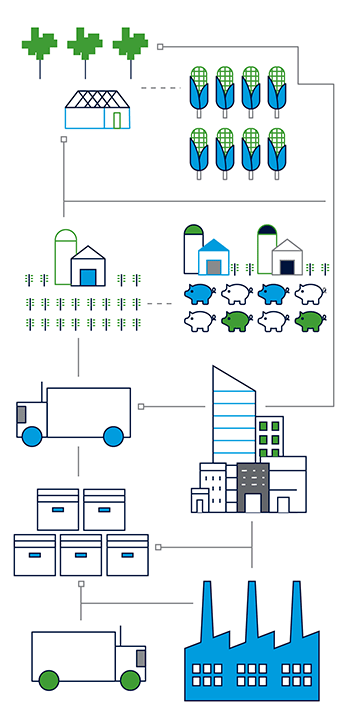
Is automation worth the investment for your agribusiness?
RSM’s F.A.R.M. (Feasibility of Automation Return Model) helps agribusinesses model the costs, potential savings and payback period of automation investment, while comparing different investment scenarios.

What should farmers include in scenario planning?
A useful farm financial forecast should test the variables that can materially change profitability and cash flow, including:
- fertiliser, fuel and other input costs
- planted area and production volumes
- different yield outcomes
- commodity price movements
- timing of expenditure and income
- working capital and funding requirements.
Rather than relying on one forecast, producers can compare best-case, expected and downside scenarios to understand where margins are most exposed and which decisions provide the greatest flexibility.
Why farm financial forecasting matters in uncertain seasons
Agriculture will always involve making decisions before all information is available. You can't control the weather, and you can't fully control input markets. What you can improve is the quality of decisions you make within that uncertainty.
This is where forecasting needs to evolve to support scenario-based decision making. Rather than betting on a single outcome, you model several: high input costs against a dry season, lower costs against an average one, and everything in between.
The producers best placed to navigate this environment will be those with the clearest understanding of the trade-offs they face, the numbers behind each decision and the range of outcomes they are prepared to accept.
Seasonal conditions will always be outside a producer's control.
The financial impact of those conditions does not have to be.
By modelling different combinations of input costs, yields and prices, agribusinesses can make decisions with a clearer understanding of their impact on cash flow, profitability and long-term value.
Plan for more than one outcome
When input costs, yields and prices are uncertain, a single forecast may not be enough. See how scenario modelling can help you understand the financial impact of different conditions before making major decisions.
Make more confident decisions in uncertain conditions
Whether you're assessing input costs, cash flow, production scenarios or future investment, RSM can help you build financial forecasts that give you a clearer view of the potential outcomes.
Talk to our agribusiness team
Make more confident decisions in uncertain conditions
Whether you're assessing input costs, cash flow, production scenarios or future investment, RSM can help you build financial forecasts that give you a clearer view of the potential outcomes.
Talk to our agribusiness team
Related insights