
 Linkedin

 Facebook
 Email
 more

RSM Australia (RSM) welcomes the opportunity to make a submission to the Senate Economics Legislation Committee in relation to the Treasury Laws Amendment (Tax Reform No. 3) Bill 2026 and the Income Tax Rates Amendment (Minimum Tax on Discretionary Trusts) Bill 2026 (together, the Bills).
Our comments are confined to the minimum tax measures (Schedules 1 to 3 of the first Bill and the Second Bill); we make no comment on Schedules 4 to 6 in this submission.
RSM is a national accounting firm with over 100 years of history working closely with family businesses across Australia. This submission draws on our experience advising private groups and family businesses, many of which have operated through discretionary trust structures across multiple generations for reasons substantially unrelated to tax.
Notwithstanding that the explanatory memorandum to the Bills (EM) acknowledges that discretionary trusts are legitimately used for asset protection and succession planning, the design of the Bills treats them principally as impugned income-splitting vehicles, without sufficient regard for their genuine and lawful role in private groups that are risking family capital to generate a return for the family.
RSM’s primary position remains unchanged from its submission on Treasury’s 2026 consultation paper dated 27 July 2026: the proposed minimum tax on discretionary trusts should not proceed. The Bills impose a broad, entity-level response to a concern said to arise from the taxation of particular individual beneficiaries. In doing so, they depart from horizontal equity, penalise taxpayers by reference to legal form, add substantial complexity to an already difficult area of law and risk disrupting legitimate business, asset-protection and succession arrangements.
If, notwithstanding these concerns, Parliament proceeds with a minimum tax measure, RSM submits that it should be redesigned so that the tax applies only at the individual beneficiary level and uses, so far as practicable, the same conceptual framework as the minimum tax applicable to capital gains. That approach would address the Government’s stated concern more directly, fairly and simply.
Our submission is set out in three parts:
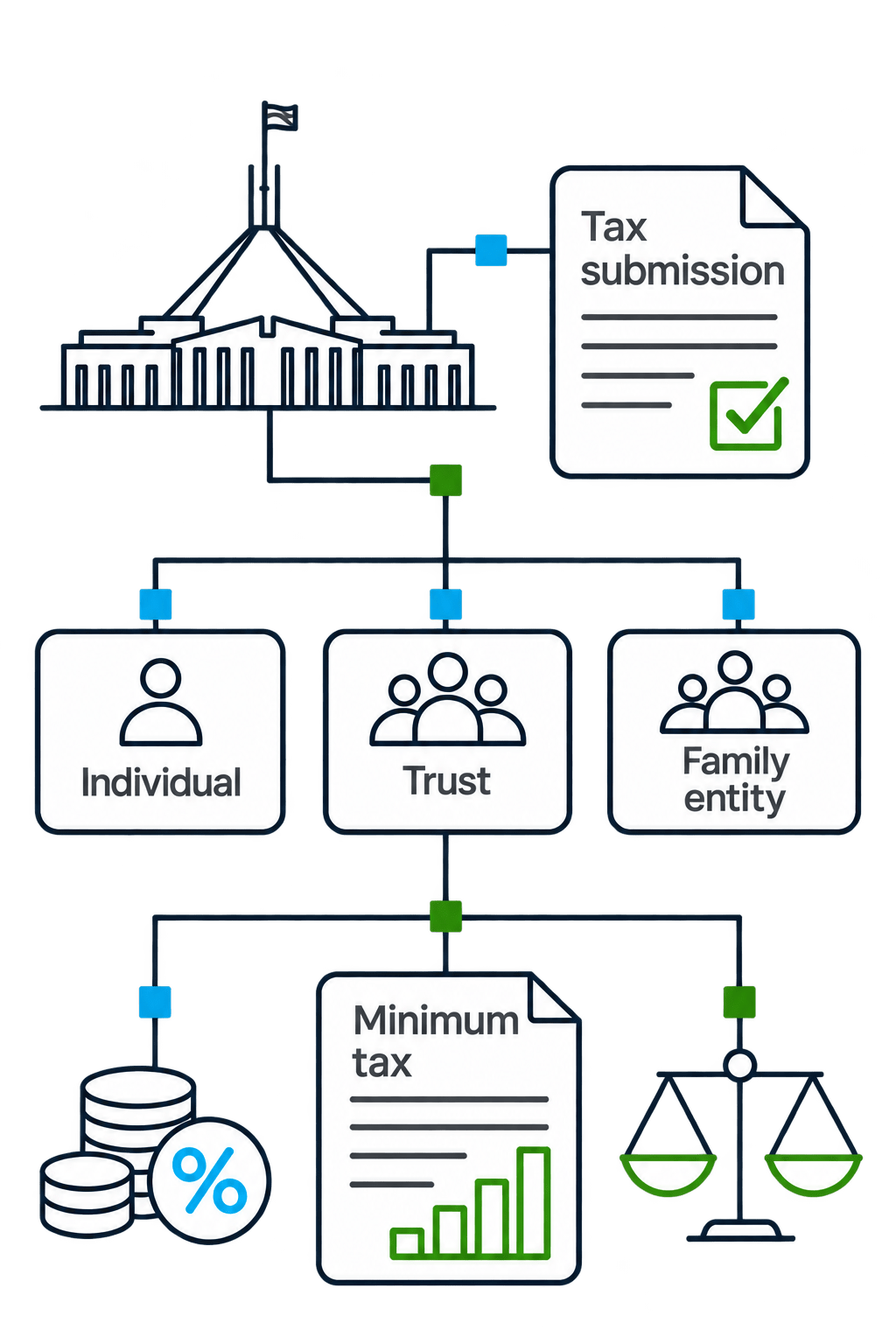

Our key recommendations
- The Bills should not proceed. Government should instead undertake a comprehensive review of trust taxation and the interaction of Division 6 with integrity rules such as section 100A, Division 7A and the family trust election regime, as well as with recent CGT reforms and also general trust law.
- If the Committee does not accept that recommendation, the Bills should not be passed until the deferred legislation dealing with notification, collection, administration, CGT interactions, residency and integrity, and the Ministerial determinations on which key exclusions depend, have been released, so the measure can be appropriately scrutinised as a complete package. Commencement, the roll-over window, and the excluded election trust (EET) election window should be correspondingly deferred.
- If a minimum tax proceeds, it should apply only to individual beneficiaries (as beneficiary-level measure) who receive relevant discretionary trust distributions, not to trustees, trusts or corporate beneficiaries (as a trustee-level measure with a double taxation implication).
- The beneficiary-level measure should adopt, so far as practicable, the same adjusted-income and minimum-rate framework used for the minimum tax on capital gains, with appropriate exclusions and adjustments to prevent duplication.
- Under a beneficiary-level model, a pre-existing trust that makes an EET election should remain outside the beneficiary-level minimum-tax regime, so distributions received by individuals from that trust are not included in their adjusted discretionary trust distribution income. This would preserve historical structuring decisions without requiring an actual transfer of assets.
- Under any model, the EET regime should be made workable in practice: the election should not be confined to the 2028-29 income year, nominations should be capable of variation for births, adoptions, marriages, incapability and the admission of a new generation, and an inadvertent departure from a nomination should not result in tax at the top marginal rate plus Medicare levy on all of the trust’s net income for that income year.
- Any integrity rules should be targeted at arrangements entered into for the dominant purpose of avoiding the beneficiary-level minimum tax. Legitimate asset-protection, succession and business structures should not be penalised. This includes replacing the ‘a purpose’ tests in proposed subsections 101AD(2) and (3) with a sole or dominant purpose test.
- The Bills defer notification and collection to future legislation. Any future collection model should not require trustees to withhold or retain tax from interim distributions, which would be practically unworkable where interim cash distributions are made before taxable income can be determined and where trust accounting income and taxable income rarely align.
- If the trustee-level model is retained, the priority amendments in under Issue 9 below should be made, in particular extended the minimum tax offset to corporate beneficiaries (avoiding a combined entity-level tax burden of up to 60 per cent) and ensuring the offset is not lost where income passes through a chain of trusts or to a beneficiary with losses.
- The policy analysis should recognise that a reasonable degree of income allocation within a genuine family business may reflect the family’s collective contribution, shared risk and foregone employment benefits, rather than artificial income splitting.
- The exclusions in the Bills for testamentary trusts, primary production income and income to which charities, deductible gift recipients (DGR) and other exempt entities are entitled are welcome. However, any exclusions should operate under the primary law rather than on yet-to-be-seen Ministerial determinations and caps. The restriction on the beneficiaries of testamentary trusts established on or after 1 July 2028 should also be removed, or at least not apply to wills executed before that date.
- The Committee should investigate and seek to remedy the significant adverse and unintended impacts of the family trust distribution tax integrity regime on private family groups across Australia and make urgent legislative amendments to address known anomalies that are causing material financial harm because not all genuine family group entities are treated as such.
Key issues for the attention of the Committee
1. The reforms should not proceed
The threshold question is not how the proposed regime should be refined. It is whether an entity-level minimum tax on discretionary trusts is justified at all. In RSM’s view, it is not.
The proposed minimum tax on discretionary trusts is unnecessarily complex and causes a variety of issues in respect of trust-to-trust distributions and distributions to corporate beneficiaries. Many privately owned Australian businesses operate as an economic group through multiple trusts and corporate entities established for legitimate asset protection and risk mitigation purposes. Disrupting these existing structures which have been lawfully established, to implement a minimum tax on individual beneficiaries who receive trust income is unnecessary, costly to implement, and will cause significant disruption to privately owned businesses across Australia.
The Government’s policy objective — a minimum tax rate on income derived by individual beneficiaries from discretionary trusts — can be met by imposing the minimum tax at the individual beneficiary level, without imposing tax on the trust or providing a non-refundable credit mechanism. Implementing the minimum tax at the individual beneficiary level would simplify the proposed changes whilst ensuring the Government’s policy objective is met, consistent with the policy taken to the 2019 Federal election, which the Parliamentary Budget Office costed (PER404) as a minimum 30% tax rate on discretionary trust distribution received by individual beneficiaries over 18 years of age, applied in the hands of those individuals.
The proposal interacts with Division 6, the Bamford principles, the family trust election regime, Division 7A, section 100A, and the new minimum tax on capital gains — already among the most complex areas of taxation law. Adding a further trustee-level tax and non-refundable offset, together with notification and collection rules that are yet to be legislated, will compound that complexity rather than resolve it.
The measure also proceeds from an overbroad characterisation of discretionary trusts as principally income-splitting vehicles. Discretionary trusts are an established part of Australia’s private business and asset-holding landscape. They are used to separate valuable assets from operating risk, protect family capital, facilitate intergenerational succession, accommodate changes in family circumstances and provide continuity when ownership and management responsibilities change.
Those functions are not incidental. For many private groups they are sound commercial reasons the structure exists. A tax system should not require commercially sound structures to be dismantled, constrained or subjected to a punitive tax outcome when the Government’s identified concern can be addressed directly at the level of the individual taxpayer.
2. Horizontal equity remains fundamental
Horizontal equity requires taxpayers in materially equivalent economic circumstances to bear materially equivalent tax burdens. The proposed regime does the opposite by creating materially different outcomes according to the legal form through which the same economic income passes.
Two families deriving the same income from economically equivalent businesses should not bear substantially different tax merely because one business or its assets are held through a discretionary trust for asset-protection or succession reasons. A private group should not be penalised because its legal structure separates trading risks from long-term assets or accommodates multiple generations.
The proposed trustee-level charge, particularly where offsets are unavailable or non-refundable, is not merely an integrity measure. It can become an additional and final tax burden attached to legal form. That is inconsistent with the longstanding conception of entity-level tax as a collection mechanism and with the architecture of Australia’s dividend imputation system.
3. Legitimate role of discretionary trusts
RSM’s experience is that discretionary trusts commonly serve several overlapping commercial and family purposes:
- Protecting accumulated family capital from future trading and professional risks.
- Allowing orderly succession where the next generation’s involvement, capability and personal circumstances cannot be predicted decades in advance.
- Facilitating shared stewardship of family assets while preserving flexibility to respond to illness, disability, relationship breakdown or unequal participation in a business.
- Supporting continuity of family businesses without forcing premature fragmentation or sale of assets.
The proposed EET regime does not fully preserve these functions. An arrangement that remains exempt only by fixing or pre-nominating future distribution outcomes may retain the legal shell of a trust while removing much of the flexibility for which the trust was established. Under proposed sections 102UYB and 102UYC, the election can only be made for the 2028-29 income year, each nominated beneficiary’s share of income and non-income earnings is fixed, and any distribution of corpus must follow the same proportions: the nomination can be varied only on a relationship breakdown or the death of a nominated beneficiary, so a grandchild born after 1 July 2028 cannot otherwise be added; and a departure from the nomination rules in tax at the top marginal rate plus Medicare levy on all the trust’s net income for that year (subject to a limited Commissioner’s discretion), with the minimum tax applying thereafter.
The Committee should note that large corporate groups access similar economic group treatment through the existing and widely adopted corporate tax consolidation regimes where income of one company can be offset by the losses of another in the same group. It is reasonable that family business structures that operate as an economic group through multiple trusts can achieve the same offsetting of income and loss making activities before determining the net group income which flows to beneficiaries to be taxed in their hands. The Bills move in the opposite direction. Because the minimum tax offset is non-refundable and cannot be carried forward, the 30% paid by a profitable trust is permanently lost to the extent the income is distributed to a related trust or individual with losses, or passes through a trust that is not itself a minimum tax trust.
4. Family businesses and reasonable income allocation
The policy discussion should also recognise the economic reality of family businesses. It is common for both spouses, and sometimes adult children or other family members, to contribute to the success and resilience of the business in ways that are not fully recorded through formal payroll arrangements.
The Committee should note that family businesses are risking family capital to generate a return for the family.
Unlike many employee households, families carrying on private businesses may not have the same practical access to paid annual leave, personal leave, parental leave, long service leave, employer-funded training, redundancy protection or predictable working hours. They also expose family capital and, frequently, the family home or other assets to entrepreneurial risk.
RSM does not suggest that all income splitting should be accepted without limit. However, some allocation of business income within the family economic unit can reasonably reflect collective effort, shared risk and the absence of benefits ordinarily available to employee households. Treating every difference in marginal tax rates as evidence of inappropriate tax planning oversimplifies the circumstances in which family businesses operate.
A broader and more principled review could consider whether spousal income equalisation or another family-unit mechanism should be available on a neutral basis to business and employee families. The present Bills should not use an entity-level tax on discretionary trusts as a proxy for that wider policy question.
5. Economic effects: confidence, productivity and entrepreneurship
The availability of rollover relief does not answer why sound business structures should need to change. Restructuring consumes legal, accounting, finance and management resources without increasing the productive capacity of the underlying business. It may also trigger duty, land-tax aggregation effects, refinancing requirements, rewritten contracts and trust-law risks that Commonwealth income-tax rollover relief cannot remove. The Impact Analysis attached to the EM itself estimates one-off implementation costs of $939m over ten years and records stakeholder estimates of up to $50,000 per restructure.
The regime would reduce confidence that long-term decisions about ownership, asset protection and succession can be made on commercial grounds. It would encourage businesses to devote scarce capital and management time to restructuring and compliance rather than investment, innovation and employment. It would also reduce agility by constraining the ability of family groups to respond to succession events, changing risk profiles and new commercial opportunities.
At a time when Australia needs stronger productivity growth and greater private investment, the tax system should not discourage entrepreneurship by imposing a structurally punitive outcome on one of the principal vehicles through which families hold business assets and risk private capital.
6. Administrative burden and impractical withholding obligations
The Bills do not contain rules for notification, collection and administration of the minimum tax, which are expressly deferred to future legislation. The Impact Analysis nevertheless acknowledges known recovery challenges with trustees, particularly corporate trustees, and foreshadows strengthened integrity settings for collection. Parliament is therefore being asked to impose a tax without seeing how it will be collected. If those settings require trustees to withhold or retain tax during the year, they will impose a significant and, in many cases, unadministrable burden on trustees. Trustees frequently make interim cash distributions during the income year to support beneficiaries, meet household costs or fund tax and other obligations. Those payments are made before the trust’s taxable income for the year can be known with confidence.
Trust accounting income, cash available for distribution and taxable net income rarely align. Differences can arise from depreciation, timing rules, provisions, accrued income and expenses, trading stock, capital gains, franked distributions, tax losses, non-deductible expenditure, specific entitlement rules and adjustments identified only when year-end accounts and tax returns are prepared.
A trustee asked to retain or withhold 30% of an estimated taxable distribution would therefore need to predict, potentially many months before year end:
- the trust’s final taxable net income
- the character of each component of that income
- which beneficiaries will ultimately be presently or specifically entitled
- the relationship between interim cash payments, accounting income and taxable income
- the availability and allocation of franking credits, capital gains, losses and offsets
- whether later events require a different allocation.
The estimate could readily exceed 30% of the cash or accounting income actually distributed, particularly where taxable income contains non-cash amounts or timing adjustments. Conversely, a prudent trustee may retain excessive cash, depriving beneficiaries and the business group of working capital. Errors could expose trustees and directors of corporate trustees to tax liabilities despite the uncertainty being inherent in the statutory design rather than the result of misconduct.
An annual notification process after taxable income has been determined would be more administrable, but it would not cure the central defect of imposing the tax at trustee level. The minimum tax should instead be assessed to the individual beneficiary through the ordinary assessment process, with PAYG instalments adjusted prospectively once the individual’s pattern of trust distributions is known. Even under the Bills as drafted, the trustee is assessed on minimum tax after year end, often after the corresponding cash has been paid to beneficiaries. Trustees will need to either retain cash or to rely on rights of indemnity and recoupment that may be impractical to enforce against family members, and directors of corporate trustees may be exposed if director penalty or similar collection mechanisms are extended to the minimum tax.
7. If Parliament proceeds, tax individual beneficiaries only
If Parliament nevertheless determines that a minimum tax should proceed, it should be imposed only on individual beneficiaries who receive relevant discretionary trust distributions. The existence of the trust as a flow-through entity is not the identified mischief. The concern is the effective rate borne by an individual beneficiary.
A beneficiary-level rule would:
- target the stated concern directly
- preserve legitimate asset-protection and succession structures
- avoid tax cascading through chains of trusts
- avoid imposing an additional tax on corporate beneficiaries and preserve the integrity of imputation
- remove the need for trustees to fund, estimate and withhold tax on income that has already been distributed
- substantially reduce restructuring and compliance costs.
Accordingly, the beneficiary-level model should distinguish between distributions from non-electing discretionary trusts, which would be included in adjusted discretionary trust distribution income, and distributions from pre-existing trusts that have made a valid EET election, which would be excluded. Appropriate commencement, eligibility, irrevocability and integrity rules could preserve the intended boundary without imposing a trustee-level tax across the entire discretionary trust population.
The EET would involve a deliberate trade-off. The trust would accept the statutory restrictions attaching to the election and would no longer retain the full distributional flexibility of an ordinary discretionary trust. In return, distributions received by individual beneficiaries from the electing trust would not enter the beneficiary-level minimum-tax calculation. This treatment would place an electing pre-existing trust in an equivalent substantive position to the exclusion contemplated by the EET regime, while retaining the simplicity and coherence of imposing the general minimum tax at the individual beneficiary level.
This is an important transitional and structural safeguard. Families made historical decisions to establish and retain discretionary trusts for asset protection, succession, estate planning and business continuity under the law then applying. Those decisions may be difficult, costly or impossible to unwind without adverse duty, financing, contractual, land-tax and trust-law consequences. A valid EET election should therefore preserve the existing trust and its assets without forcing an actual restructure merely to avoid the new minimum tax.
8. Adopt the CGT minimum-tax framework
The beneficiary-level measure should use, so far as practicable, the same conceptual taxing basis as the minimum tax on capital gains. Common concepts would be simpler to administer and would avoid constructing a separate trustee-level tax-and-credit architecture for a related minimum-rate policy.
The new minimum tax on discretionary trust distributions could be legislated in the same manner as the legislated minimum tax on capital gains. We recommend that the amount to which the minimum tax applies be calculated on an adjusted basis, so beneficiaries can benefit, in the same way as salary and wage earners, from tax-deductible donations and concessional superannuation contributions. The adjusted amount to which the minimum tax would apply could be calculated as follows:
- total assessable trust distributions from discretionary trusts (including capital gains and franked dividends)
- less capital gains included in the assessable trust distributions, as they will be subject to their own minimum tax regime
- less primary production income included in the assessable trust distributions, to ensure primary producers can continue to access averaging and farm management deposits
- less concessional superannuation contributions made by the individual
- less donations made by the individual to a deductible gift recipient
- equals, adjusted discretionary trust distribution income to which the minimum tax applies.
There would be no change to the general refundability of franking credits to individuals; rather, franking credits attached to distributions would first be applied against the beneficiary’s minimum tax liability, with only the excess being refundable.
The company tax rate applicable to discretionary trust distributions received by a corporate beneficiary would remain unchanged from the existing law, which allows base rate entities to adopt the lower 25% company tax rate. This is justifiable on productivity grounds, given that those base rate entities will either operate a small or medium business of their own or be integrated with a family group in which a trust operates such a business.
Integrity aspects
We understand Treasury is concerned that the minimum tax could be sidestepped by a distribution to a corporate beneficiary, which then allows the dividends to be paid to individual shareholders without application of the minimum tax to the individual shareholder. We do not share the view that this is a material revenue risk deserving of added complexity. In our view, that risk does not justify denying corporate beneficiaries any recognition of the minimum tax paid by the trustee, for the following reasons:
- A corporate beneficiary’s retained profits remain subject to Division 7A and are ultimately taxed in the shareholders’ hands when paid as dividends, so the concern is one of deferral rather than permanent revenue loss.
- If the shares in the corporate beneficiary do not carry discretionary dividend access rights and are held by a discretionary trust, as would normally be the case for asset protection and estate planning purposes, the dividend when flowing through the second discretionary trust would itself give rise to the minimum tax when received by an individual beneficiary.
- If the shares in the corporate beneficiary do not carry discretionary dividend access rights and are held by individual shareholders, this should not present any material revenue concern, as the same position could be achieved if the trust assets were transferred to the company under the proposed roll-over relief, an outcome the Government has expressly facilitated.
However, if Treasury considers there is a material revenue risk, a separate class franking account could be adopted by any corporate beneficiary that receives trust income from a discretionary trust. To prevent ‘recovery’ of the minimum tax at the individual shareholder level through refundable franking credits, the franking credits within that account would be non-refundable when dividends sourced from a discretionary trust distribution are declared to shareholders. Appropriate ordering or proportioning rules would also be needed to determine the extent to which dividends are sourced from that account. We acknowledge that a similar tracking model was considered as the alternative option in the Impact Analysis and was not preferred, principally because it would preserve deferral through corporate beneficiaries. In our view, deferral (as distinct from a permanent reduction in tax) is an inherent feature of the corporate tax system that the Government accepts for companies generally, including companies formed under the proposed roll-over.
9. If the trustee-level model is retained: priority amendments
We recognise that the Committee may recommend that the Bills be passed in substantially in their current form. In that event, we urge the Committee to recommend, at a minimum, the following amendments:
Corporate beneficiaries – proposed section 101AG denies the minimum tax offset to corporate beneficiaries. Where $100 of minimum tax income is distributed to a resident company, the trustee pays $30 of minimum tax, and the company pays a further $25 (base rate entity) or $30 of company tax on the same $100. That is a combined rate of 55 to 60 per cent before any tax on dividends, with franking credits arising only for the company tax. This materially exceeds the current top personal marginal rate of 47% (including the Medicare levy) and is not a minimum tax in any meaningful sense. The offset should be extended to corporate beneficiaries, with the tracking rules described above to prevent its conversion into refundable franking credits.
Chains of trusts and losses – The offset is non-refundable and cannot be carried forward. Where a minimum tax distributes to a trust that is not a minimum tax trust, the interposed trustee can use the offset only against its own liability and the ultimate beneficiaries receive no offset at all. Similarly, where a recipient trust has current or carried-forward losses, the offset is wasted. The offset should flow through to the ultimate beneficiaries regardless of the status of interposed trusts and should be capable of being carried forward.
Interaction with the minimum tax on capital gains – capital gains form part of a beneficiary’s share of adjusted net income of a minimum tax trust, while individuals are separately subject to the minimum tax on capital gains. The interaction between the two regimes has been deferred to future legislation. The Bills should not commence until it is clear that a capital gain distributed through a discretionary trust cannot bear a minimum tax twice.
Electable regime – the EET should be made a genuine alternative to restructuring by allowing the election to be made in any income year of the new regime, permitting variations for births, adoptions, marriages, incapacity and the admission of a new generation, and replacing automatic revocation (with tax at the top marginal rate on all of the trust’s net income) with a proportionate consequence, such as applying the minimum tax only to the non-conforming amount.
Testamentary trusts – the requirement that testamentary trusts established on or after 1 July 2028 have only individuals, exempt entities or special disability trusts as beneficiaries will require many existing wills to be redrafted, including for testators who no longer have capacity to make a new will. It should be removed, or at least not apply to wills executed before 1 July 2028. The ‘a purpose’ integrity tests in proposed subsections 101AD(2) and (3) should be replaced with a sole or dominant purpose test.
Legislative instruments – key elements of the regime depend on Ministerial determinations that have not been released, including further exclusions from the definition of minimum tax trust, the conditions and cap applying to income of charities, DGRs and other exempt entities, and matters affecting the new definition of fixed trust. At a minimum, exposure drafts of these instruments should be released before the Bills are passed.
Fixed trust definition – we welcome the broader definition of fixed trust. As it will apply across the whole of the tax law, Treasury should confirm its consequences for other provisions that rely on that concept, including the trust loss rules and the holding period rule for franking credits, and provide transitional relief where a trust’s status changes.
Timing - the roll-over window opens on 1 July 2027, and the one-off EET election must be made in the 2028-29 income year, yet the administrative, collection and integrity rules are not yet available. Families cannot make informed and largely irreversible decisions about restructuring or electing without them. Commencement and these windows should be deferred until at least 12 months after the complete package has been enacted.
Conclusion
RSM recommends that the Committee recommend that the Bills not proceed. The proposed regime is not a proportionate response to the Government’s concern. It would impair horizontal equity, penalise legitimate business structures, impose substantial administrative burdens and create adverse consequences for business confidence, productivity, agility and entrepreneurship.
If Parliament nevertheless proceeds, the measure should be redesigned so that any minimum tax is imposed only on individual beneficiaries and follows the same broad taxing basis as the minimum tax on capital gains. That approach would address the stated concern about individual tax outcomes without imposing a punitive and complex entity-level regime on trusts that perform genuine commercial, asset-protection and succession functions. If the trustee-level model is retained, the amendments set out in Issue 9 should be made as a minimum, and the measure should not commence until the deferred administrative, collection and integrity rules are available for scrutiny.
We would welcome the opportunity to discuss this submission with the Committee.
Yours sincerely

Liam Telford
Partner, Tax Technical



A full copy of RSM's submission on the Minimum tax on discretionary trusts is available for download below.
If you would like to read RSM's previous submission on the minimum tax on discretionary trusts, please download a copy below.
How RSM can help
RSM's tax specialists work with founders, investors, venture capital funds and innovative businesses at every stage of growth. From startups to established businesses, we provide practical tax, structuring and commercial advice to help you navigate change, access incentives and achieve your growth ambitions.
Whether you're assessing the impact of proposed tax reforms or planning your next move, speak with your local RSM adviser or learn more about our tax services.
How RSM can help
RSM's tax specialists work with founders, investors, venture capital funds and innovative businesses at every stage of growth. From startups to established businesses, we provide practical tax, structuring and commercial advice to help you navigate change, access incentives and achieve your growth ambitions.
Whether you're assessing the impact of proposed tax reforms or planning your next move, speak with your local RSM adviser or learn more about our tax services.