
 Linkedin

 Facebook
 Email
 more

Chapter 3
Developing an implementation roadmap
Chapters
1 The AI journey every business is taking
Learn about AI, how businesses are using it, and what the latest trends show us
2 Understanding AI risks
Common AI risks and legal considerations, plus how to protect your business
3 Developing an implementation roadmap
Step-by-step implementation roadmap for effective AI adoption
4 Making AI part of everyday work
Leadership’s role in AI adoption and how to overcome staff hesitation
5 Measure, iterate and improve
Why AI adoption can never be ‘set and forget’
While an increasing number of small and medium sized enterprises (SMEs) in Australia are using AI, most are still in the early stages of their journey.
Some started using it informally and were disappointed by the outputs or concerned about the risks, and abandoned adoption entirely. Others saw excitement quickly fade when staff realised that doing something faster doesn’t always get better results. Just because you can generate 50 LinkedIn posts in seconds doesn’t mean those posts will engage and attract new followers!
Whatever your business’s previous experience with AI, there is a path you can take to considerably improve your chances of achieving (consistent) success. Far from ad hoc, this path is:
- proactive
- informed
- intentional
- measurable.



 The starting point: Cloud-first
The first step in every AI journey is to understand what information AI needs to complete the tasks you want it to do.
More often than not, this will require your business information to be in a digital format, within reasonably integrated systems.
Where data is incomplete, inconsistent or difficult to access, the quality of any AI output will be limited.
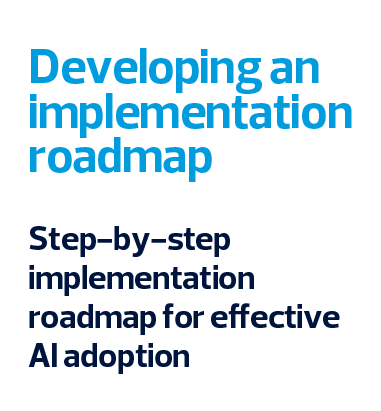
Moving information out of siloed, offline or paper-based processes and into integrated cloud-based systems enables that data to be connected and put to work.
Where trusted data flows freely, your business can ultimately reach a point where AI is positioned to act as a second brain – ready to help turn information into insight and action.
For businesses still reliant on legacy processes, modernising core systems and operations is a necessary first step to realising the potential of AI.
 The next step: Finding use cases
When considering where to implement AI, it's important to look at the big picture rather than focussing on isolated and infrequent tasks completed by just one or two people.
The most successful AI initiatives are usually those that target activities which are performed frequently by many people and consume considerable time.
Also keep in mind that AI is not always the best solution for every use case. Often robotic process automation (RPA) is faster to implement, cheaper and equally capable of delivering the desired outcome.
The goal is always to identify the right technology for the problem at hand, not apply AI for its own sake.
To find suitable use cases, start a conversation with people in various divisions of the business (finance, marketing, operations, admin) and brainstorm:
Which tasks are repetitive, time consuming or heavily manual?
Where do people spend significant time searching for, creating or summarising information?
Which processes create bottlenecks or delays?
What decisions could be improved with faster access to data and insights?
Which customer or employee experiences could be enhanced through greater automation, personalisation or self-service?
From these discussions, you can then identify potential quick wins that are relatively easy to implement and would have a substantial impact. For example, a starting point could be a task performed by five people in the finance team every week that takes three hours each. If AI or automation reduces that effort to a brief review and approval process, the time savings can really add up.
 The right fit: Assessing solutions
There are generally two tracks a business can go down when adopting AI:
Track A: Leveraging AI-enabled business software
Once you have a use case, you can investigate whether pre-built business software exists to solve that problem. For example, Xero to help with finance management or ShiftCare for NDIS providers. Both were designed to do much of the heavy lifting in their respective domains, and both have introduced new AI features to try make users’ lives easier.
Sometimes the entire solution will be available “out-of-the-box”. Other times it will require customisation to meet your specific needs.
You could also explore custom development through AI solutions providers. Depending on your industry and level of regulation, these can provide a cost-effective alternative with the flexibility to be fully tailored to your business's way of working.
Do you already have sophisticated software but aren’t using it to its full potential?
Learning how to leverage AI in existing tools is one of the fastest and most cost-effective ways to realise value.
Track B: Deploying new AI assistants
Track B involves adopting AI assistants such as Microsoft Copilot, Claude or ChatGPT and integrating them into daily workflows.
When used consistently across teams, they can become a powerful productivity tool and create a foundation for broader AI adoption.
With this type of intentional adoption, businesses will often invest in commercial licences for advanced functionality and enhanced security. Some AI assistants can be configured to operate in a “fenced” environment where the business’s confidential data and intellectual property remain secure.
 Building the business case: Modelling for ROI
After selecting a use case and deciding on a preferred track to pursue it, you will want to know:
Is the investment likely to be worth it?
Often, the tangible answer to this comes down to time calculations.
If a process consumes three hours a week across five employees, that's more than 700 hours a year.
Even modest efficiency gains can quickly create a compelling business case when you multiply them across a team or the entire organisation.
The best ROI assessments also need to consider the intangibles though, such as:
- easier reporting
- accelerated decision making
- fewer errors
- more straight-forward compliance
- improved customer and employee experiences.
Scenario and financial modelling can be especially useful to help calculate the expected return on investment, without ignoring the intangible benefits expected from adoption.
The greatest return often comes from giving skilled people more time to focus on work they love rather than work they have to do.
 From plan to action: Developing a pilot
Once a promising use case has been identified and the potential ROI calculated, the next step is to develop a pilot. This involves testing the technology with a small group of users and refining the approach.
The pilot is also a good opportunity to ensure strong foundations are laid surrounding use of the new tool or software. This means following and testing best practice training, processes and governance so you can learn valuable lessons and use them to inform strategies for further roll outs of the technology across the organisation.
AI adoption checklist
Explore the AI capabilities in existing business software
Engage with business divisions to identify use cases
Confirm that use cases solve a genuine business problem
Investigate the technology solutions available
Model the expected return on investment
Implement the foundations necessary to support the solution
Understand the risks and develop a risk mitigation plan
Invest in the solution and training on best practice use
Select a pilot group and design effective training
Choose a project owner and adoption champions
Set measurable success criteria
Roll out the solution to the pilot group
Measure, iterate and improve
Ready to take the next step in your AI journey?
Whether you're just starting to explore AI or looking to maximise the value of existing initiatives, RSM can help. Our advisers can work with you to identify opportunities, navigate risks and develop a practical AI strategy aligned with your business goals.
Get in touch with our team to discuss how we can support your AI journey.
[Image once PDF is created]
Make AI work for your business
Turn your AI ambitions into action. Download our AI adoption checklist to help your business identify opportunities, assess readiness and plan for successful AI implementation.
thinkBIG
Cutting through the AI hype